Sunday, April 10, 2022

When it comes to passion about superheroes, I'm Absent Man

If you're part of the majority of Americans who lover superheroes (68%, according to a recent Morning Consult poll), get ready to hate me.

If you love Batman, Superman, Wonder Woman, Spider-Man (a superhero with a hyphen!), The Flash or Thor, get ready to be angry.

My name is Brad and I don't like superhero movies.

I fact, I don't like superheroes. Never have.

I know. Put down your X-ray vision or whatever Spider-Man (a hyphen!) shoots out of his wrists.

I'll offend you with the next sentence, too: When I was a kid, I presumed only children liked superheroes. I still don't understand why so many adults lose their minds over a movie about a cartoon character.

Is that right? Are all the Marvel and D.C. characters from cartoons? (I had to look up what the companies are. What the universes are.) I genuinely don't know.

The first real superhero movie of my generation was the "Superman" with Christopher Reeve. It was a throwback to a few decades earlier when people the age of my parents went to the local theater and watched superhero movies or cowboy movies while spending a quarter for popcorn. It was charming, although I remember going to that movie in my teens and thinking, "Isn't this kind of a kids' movie?"

I was wrong. Way wrong.

Over the past several decades, the D.C. and Marvel characters have owned the movie world. Every year, there are new superhero movies, featuring characters that I've never heard of. Enough so that I rarely know they're superheroes.

Of course I know Superman and Batman and Spider-Man. I know Wonder Woman (mostly from the TV show starring Lynda Carter). But I'd never heard of these other characters.

I presumed the first Black Panther movie was about Huey P. Newton or Bobby Seale, not a superhero.

I presumed Captain America was about former Dallas Cowboys quarterback Roger Staubach, not a superhero.

Morbius? Doctor Strange? Black Adam? Iron Man?

Those all seem fake.

Apparently, I missed out on a huge cultural trend. I've spent my adulthood scoffing at superhero movies, then seeing them be wildly successful. How did I miss this? As a kid, maybe I was too busy collecting baseball cards or watching "Hogan's Heroes" to read those comic books (at my house, the comic books were mostly "Archie" and "Richie Rich," not superheroes).

But it happens, year after year after year. I hear the excitement for a new superhero movie. "I'm so excited to see the new Fandango Woman and Tricycle Man movie!" people say.

I don't get it. I don't go to superhero movies and don't plan on starting.

However . . . I did find comfort in that Morning Consult poll that showed that more than two-thirds of Americans are superhero fans. Millennials are by far the group most interested in superheroes, whether it's going to movies, buying comic books or dressing up as them. Gen Z is significantly less interested.

So go ahead and enjoy going to the next Asparagus-Man movie or reading the next issue of the comic book about Scrapbooker and the Committee of Pencils. I'll sit it out, along with my Gen Z friends.

Maybe we'll be watching a movie about Hugh Jack-Man, Paul New-Man or  Morgan Free-Man – a joke that reveals how old my cultural views are.

But if that were the case, at least I'd understand the superheroes and their random hyphens.

Not like the new "Pink Lady and the Legion of Grasshoppers" movie.

Reach Brad Stanhope at bradstanhope@outlook.com.

Sunday, April 3, 2022

Baseball season's back, so it's time to finally fix some things

Baseball should be better.

The major leagues return this week after two seasons affected by the Covid-19 pandemic followed by a 99-day lockout that delayed the start of spring training and pushed back opening day by a week.

The lockout was a bad look, but do you know what's worse? Baseball is . . . (looks around) . . . kind of boring.

I've loved the sport for decades, but it's gotten harder to watch over the past 20 years. I can already hear all my baseball-loving friends objecting, but they're wrong and I'm right.

Baseball is boring, even when the Giants are winning 107 games.

Consider two facts:

  • There are far fewer hits, as well as fewer balls in play than at any time. The league-wide batting average keeps dropping (last year's was the sixth-lowest in history) while hitters strike out 50% more often than they did 30 years ago. It's not uncommon to play 20 minutes and have only a few balls put in play. That's boring.
  • Games are much longer. Forty years ago, the average game took 2 hours, 33 minutes. Last year, the average game took 3 hours, 10 minutes.

Compared to even a few decades ago, there is way less action spread over way more time.

And baseball – unlike other major professional sports – responds to problems by doing nothing. Maybe forming a committee to study the issue.

The NFL changes rules to encourage passing and scoring. The NBA eliminates defenses that slow down the game.

Baseball forms a group to look at how to knock 30 seconds off a game that takes 3 hours, 10 minutes.

Baseball has always been a slow game – a daily sport with a lot of time spent standing around on the field and a lot of relaxing in the stands. But the recent trends (encouraged by advanced statistics) lengthened games and decreased action to the point that it's like watching curling (no offense to Canadians).

Changes are coming. National League teams will use a designated hitter this year after 50 years of it being an American League-only rule. Next year, there will almost assuredly be a pitch clock, forcing pitchers to work faster. There will be bigger bases to encourage base-stealing. There will be some sort of rule banning the infield shift, allowing more hits to go through.

Those are all good, but baseball should go further. The sport needs to speed up – not just to please kids who love video games, but to keep people like me engaged. Three-hour games with 12 total hits are hard to watch day after day.

Major league baseball should learn from the NFL and NBA and keep making changes. A shorter season? Maybe. Move the pitching mound back to encourage hitting? Consider it. Force teams to lose their designated hitter when they pull a starting pitcher in order to encourage leaving that pitcher in? Sure. Bigger bats or harder infield? Maybe.

There are surely unforeseen consequences for every change, but I know this: They're worth considering.

Baseball is still a great game, but if my favorite childhood sport wants to fully capture people like me – and more importantly, gain interest among people under 50 – it needs to change.

The new (potential) rules are a good start.

Keep tweaking the sport. Get more action. Take some risks.

Stop the slide toward curling!

Reach Brad Stanhope at bradstanhope@outlook.com.

Sunday, March 27, 2022

A story of cancer, morbidity, mortality and me

The words "morbidity" and "mortality" are way too similar.

That fact made my recent cancer experience worse than it had to be.

Yeah, cancer.

This story starts in early February, when I got a dreaded message from my health care provider: "Here is the result of your biopsy: Pigmented basal cell carcinoma nodular type-extending to both peripheral and deep tissue edges."

I knew a few of the words. Including carcinoma. It's cancer.

Oh no.

Really, oh no.

Not what I expected, nor what my doctor expected. Cancer. And I found out as I was getting ready to go to bed.

I sat down for a second. Reminded myself that I trust God for everything. Told Mrs. Brad: "Well, I have cancer."

It was scary. It was one of those moments you hope to never encounter. It was one of those moments that many, many people encounter. It's still unexpected.

So, after talking with and hugging Mrs. Brad and again reminding myself that I trust God for everything, I did what we all do: I looked up the prognosis on Google. I knew "carcinoma," but didn't know the other words.

The first websites were generally positive: It's the most common form of cancer. It's treatable.

Then I saw one that said "the morbidity may be considerable" and had to sit down.

Considerable morbidity? I found another site that said, "the morbidity is nearly 100%."

Again: I had just seen a cancer diagnosis. Now I see that morbidity is nearly 100%.

My head was spinning. I had to sit down. I reminded myself again that I trusted God for everything, even if this turns out bad.

NEARLY 100% MORBIDITY!

Then I looked up "morbidity."

It means, "the condition of suffering from a disease." What?

So having cancer means there's a considerable chance at having a disease? It means there's nearly 100% chance of suffering from a disease?"

HOW IS IT NOT 100%????

IF YOU HAVE CANCER, YOU HAVE A DISEASE!

AND MORE IMPORTANTLY, WHY DOES MORBIDITY SOUND SO MUCH LIKE MORTALITY?

I didn't sleep well that night. (Although this is one exception to the advice to not Google your symptoms. The common fear is that you have cancer, so if you already know it's cancer, it can be reassuring. Like hearing that it's common and treatable – although "morbidity" may confuse you.) The following days were scary and sobering, particularly until I could talk with a doctor.

I told my family and some friends. I scheduled a procedure to cut out the cancerous section of skin. I kept reminding myself it's about morbidity, not mortality (although as a Type 1 diabetic, I now have co-morbidities. Not great, but it could be worse: I could be a Raiders fan.).

To bury the lead, as we say in journalism, I had minor outpatient surgery (Mrs. Brad and I disagree whether having a quarter-sized chunk of skin taken out of my torso counts as surgery, but I insist on casually referring to it as "my cancer surgery") and waited for the results. They came back a week later: The lab says it's all gone. I just have to return for checkups to catch any recurrence early.

So it's really a happy ending. But here's what I learned:

• I can trust God with everything, even if it's bad news.
• It's uncomfortable to have skin removed from your body.
• People are sympathetic when they hear you have cancer, even if it's "minor" and even if you joke about it.
• Morbidity and mortality are very different things.

No. 1 is the most important, but No. 4 is pretty significant.

Reach Brad Stanhope at bradstanhope@outlook.com.

Sunday, March 20, 2022

Speaking up for secondary words: The potatoes and meat of language

My friends, I come before you on behalf of pepper and butter. And arrow. And all they represent.

They've been overlooked too long., left in the shadow of their more famous counterpart. Always listed second.

I come before you in support of the inanimate versions of Garfunkel, Eve, Clark, Clyde and Juliet (to Simon, Adam, Lewis, Bonnie and Romeo).

Why, for instance, do we always say salt and pepper in that order? What's wrong with pepper? Why can't it be first? Did anyone ever consider how pepper might feel always being relegated to the vice president status among spices? Maybe it doesn't matter, but salt being listed first is as certain as taxes and death.

See?

Why is it always bread and butter? You could have butter and bread and it would be the same thing, right?

Bow and arrow? Sure, you need a bow to shoot an arrow, but what's a bow without an arrow?

Gentlemen and ladies, let me make a case. When it comes to the order in which words appear, we sometimes treat it like we're comparing oranges and apples, but we're not. That "mom" always comes before "pop" while describing a small business isn't something that's done with mirrors and smoke. It's part of the potatoes and meat of our ordinary language.

See my point?

It begins in childhood. That's when Dr. Seuss teaches us that the troublemakers in "The Cat in the Hat" are Thing 1 and Thing 2. Always in that order. Girls and boys (see?) who read those books are taught that Thing 1 always comes first, even though it doesn't matter.

We're taught that chips always follows fish. We're taught that certain stores carry clothes for big and tall men. Why should "big" men get priority? I say those stores are for for tall and big men.

This is part of the pull and push of our language, the take and give – whether the words are spoken on written down in white and black. I'm not familiar enough with other languages to know whether it's universally true that inanimate pairs (or even people and animals: How about Jerry and Tom? How about Scratchy and Itchy?) are always said in the same order, but here in the United States, we should do more for the underdogs. In the home of roll and rock, under the stripes and stars, we should support the secondary words in two-thing parings.

Why aren't they breakfast and bed inns? Why isn't the song about ivory and ebony? Why don't people chill and Netflix? Why is it always yin before yang?

And why, for crying out loud, does peanut butter always get first billing ahead of jelly? You need both.

I suspect it's because we're lazy. Once something gets stuck in our mind (thunder and lightning; flotsam and jetsam), it sticks. Perhaps it's always been that way. Perhaps when the original people (gatherers and hunters, perhaps?) talked, they paired things up the same way every time.

Maybe that makes it easier to survive. Maybe that's a way our language adapted to make it simple.

I complain, but that's because I'm not stuck between a hard place and a rock.

Reach Brad Stanhope at brad.stanhope@outlook.com.

Sunday, March 13, 2022

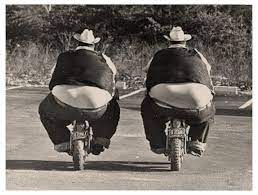
Ridiculous fame is at least as old as two obese twins on motorcycles

Any time I hear someone is a "YouTube star" or is famous for TikTok videos, I roll my eyes. How crazy is it that all you have to do to be a celebrity in modern America is make a dance video or record yourself doing something stupid that people will watch?

It's absurd.

Then I remember the McCray brothers.

You may remember them. Or maybe you know them as the McGuire Brothers, their name during a short-lived wrestling career. Regardless, if you're 50 or older, you probably know these obese twins.

Billy and Benny McCrary were famous because they were noted in The Guinness Book of World Records (now Guinness World Records) as the record-holders as fattest twins. It seems weird now, but I suspect 75% of the students in my elementary school knew who they were – if not by name, then by the most famous photo of them, the one that graced every annual Guinness Book of World Records during my youth. Benny and Billy sitting on minibikes. More accurately, enveloping minibikes.

Each of the McCrarys weighed more than 700 pounds. You read that right: Between the pair of them, they weighed 1,500 pounds. That fact and their inclusion in The Guinness Book of World Records (and especially the photo) made them celebrities.

In a way, they already were celebrities before my friends and I learned about them: They were regionally famous as wrestlers as part of the National Wrestling Alliance and New Japan Pro Wrestling. Why wouldn't they be? Two 700-pounders was a great draw!

The Guinness Book of World Records was a sensation in the 1970s, much like disco and pet rocks. At least it was a sensation to school kids. A few students would get the book through one of those book fairs at school and we'd pass it around. Read and see pictures of the fattest twins. The longest fingernails. The oldest living man. Fattest cat. Most tattoos.

The editors of the book knew to put in photos and the McCrary brothers were the stars of the book. If their photo wasn't the first, it was one of the first and the fact they rode minibikes (apparently they took a motorcycle trip across the nation) made it undeniably interesting. Everyone knew the McCrary twins.

I'm sure the parents of my generation thought this was stupid, in the same way they thought our music, our fascination with pet rocks and our love of "Welcome Back, Kotter" was stupid.

But the McCrary Brothers were undeniably celebrities. Do you know how I confirm that? They appeared on "The Tonight Show" with Johnny Carson at the end of their 3,000-mile motorcycle trip.

Billy died in 1979 due to injuries from a motorcycle accident. Benny died of heart failure in 2001, at age 54.

Here's the thing: The McCrary Brothers were one-trick ponies. They were massively obese. And they were twins. Their fame was enhanced because of a single picture: Them riding tiny motorcycles.

It didn't seem strange in the 1970s that they were celebrities for that, which is important to remember every time we get mad in 2022 about someone being a celebrity for something dumb.

So maybe dumb fame (YouTube star! Tik Tok video!) isn't new.

Maybe it's as old as two guys sitting on a tiny motorcycle to create interest among elementary school students.

Reach Brad Stanhope at bradstanhope@outlook.com.

Sunday, March 6, 2022

Valid criticism or being negative? How Mrs. Brad and I watch sports

I treat sports like the athletes are deliberately trying to hurt me. Mrs. Brad treats sports like a family get-together.

Those differences may be due to our personalities and histories. They're possibly due to gender stereotypes: That men compartmentalize and women are more relationship-oriented.

But here's the fundamental problem: While watching my favorite teams, I criticize players. I expect the worst from them and often reference previous mistakes.

She considers me "negative" and will clap back when a criticized player does something well, insisting that I didn't believe in him.

I say I was just being honest.

She says I'm not being supportive.

And we keep watching the game.

I have a theory on why this happens, but it comes with spin to make me look more reasonable.

The theory: Like most sports fans, I have spent a lifetime being disappointed by my favorite teams. I love the Warriors, Giants and 49ers (in that order) and while they've all had championship runs, they– like virtually all teams – spend much more time being bad. Sometimes (Warriors) they were dreadful, sometimes (Giants) they occasionally got close enough to just break my heart.

(Note: The post-2010 championships of the Giants and Warriors have been thrilling. But all those titles came after a lifetime of disappointment. I was a fully formed fan before their glory days started.)

My hypothesis is I learned to protect myself against the inevitable heartbreak by expecting the worst. That means I frequently say things like, "Oh, this is going to be an excruciating loss" or "that mistake is going to cost them the game."

It's not being negative, it's being self-protective. (So I say.)

I also merely state facts. If Stephen Curry misses his first 10 shots, it's accurate to say he's having a terrible shooting night. When Jimmy Garoppolo throws high passes over the middle, it is correct to say that will lead to interceptions. When the Giants bring in a reliever and he walks the first two batters, it's valid to call that a terrible start. (So I say.)

Mrs. Brad sees it differently.

She's a legit sports fan – she grew up with a football-coach dad and married a sports writer, so you could say she had no option. That would ignore the fact that when I was a sportswriter, I would often come home from work to find her watching NBA playoff games. Last summer, she suddenly started watching five-hour daily broadcasts of the Tour de France and other European cycling races. She now has theories on what makes a great cycling team. She remembers NBA facts that I forget.

But to her, athletes – stars like Steph Curry, but even more so, role players for whom she develops a love (Marquese Chriss, Kirt Manwaring, Andris Biedrins) are friends or family and should always be supported.

If you like them, you shouldn't criticize them. To her, me griping about missed free throws by Andrew Wiggins is like me criticizing one of our sons.

When I grumble, "That's a terrible shot!" or bark, "throw a freaking strike!" she tells me to stop being negative. Ultimately, when another shot goes in or the pitcher gets out of the jam or the quarterback throws a touchdown pass, she tells me I didn't believe in them.

I say I believed in them. My criticism was valid! (So I say.)

We just see things differently. Like my love of early 1970s pop music. Or her enjoyment of "Project Runway." Or our differing opinions about yogurt.

As we near our 37th anniversary, the differences are what keep it interesting, I guess. But everything would be perfect if the Warriors would get into their offense quicker and Giants pitchers would throw strikes and the 49ers stopped committing pass interference penalties.

Which is negative. Or valid criticisms. (So I say.)

Reach Brad Stanhope at bradstanhope@outlook.com.
Sunday, February 27, 2022

Ranking the top seven pieces of household furniture

It's one of the oldest debates in the world: What's the best piece of household furniture?

Never heard anyone argue over that? Well, you don't live in my brain, because it's been a topic of debate since I thought of it a few weeks ago.

Is it a bed? The kitchen table? The couch? A favorite chair?

Put another way: If you could only keep one piece of furniture, what would you pick?

The MVP – most valuable piece (of furniture) – seems obvious to me, but the rest of the rankings aren't.

Until now. Here, by (un)popular demand, is the definitive ranking of household furniture, based on versatility, utility and how your life would look if they disappeared.

7. Desk. This became increasingly important for many of us since March 2020. Having a dedicated place to place your computer and other such items is valuable. Trust me. I'm sitting at my desk (a converted sewing table) as I write this. However, it's not irreplaceable. Just ask anyone working at a kitchen table (see below).

6. Living room chair. You could survive without a living room chair, but you wouldn't prosper. In virtually any house in America, the most-used piece of furniture is the best living room chair, invariably placed in a direct line from the TV. It's like Kevin Durant when he played for the Warriors. Not necessary, but sure makes things better.

5. Kitchen table. Even if you don't use it for meals, it provides a large, flat storage area for papers, mail and anything else. It's also valuable when needed: If you only use it a few times a year, those are important meals.

4. Coffee table. My friend Nick convinced me that it belongs here because of versatility: You can put food on it, use it as an ottoman and even use it for storage. He's right. The Swiss Army knife of furniture.

3. Chest of drawers/dresser. An aside: When Mrs. Brad and I married, our first big argument was over where to put the chest of drawers. We kept arguing and neither of us could believe that the other person was serious: Why would you put a chest of drawers there? Ultimately, we realized that what Mrs. Brad called a chest of drawers is what the rest of the world calls a dresser – the longer, lower item with drawers and a mirror. It was the last major argument I won. On point for these rankings: What happens if your chest of drawers/dresser disappears? Do your clothes go in boxes? This is the ultimate storage solution – furniture as storage!

2. Bed. Back in the day, I could sleep anywhere. On a couch. In a chair. On the floor in either a sleeping bag or with a blanket. In a car, if necessary. The older I get, the more important the bed becomes. This provides a service no other piece of furniture provides: A place for blissful sleep. That's invaluable.

1. Couch. The king of the castle, because it is a quadruple-threat. It can be a place for (multiple) people to sit. It can be a favorite chair. We can eat while sitting on a couch, making it a replacement for a kitchen chair and table. The final bonus is that serves as the backup to your bed. You can sleep on the couch. If you only had one piece of furniture, this would be the pick. It's the Bo Jackson of furniture.

Reach Brad Stanhope at BradStanhope@outlook.com.

Sunday, February 20, 2022

The naked truth about medical patients and those paper robes

So I was at the doctor's office recently, ready for a minor procedure.

The physician's assistant did all her work – taking my blood pressure and pulse, asking what medications I take, confirming my pharmacy, asking why I was there (aren't all of those things written down? Didn't I already tell multiple people these things and fill out a form about them? Is this an effort to catch me in a lie?).

She informed me that as a diabetic, I would have my feet checked, so I needed to take off my shoes and socks. Then she handed me one of those paper robes and told me to put it on and have the opening in the front.

She started to leave.

"Um, I have a question," I asked.

She stopped, no doubt wishing I would just follow orders.

"What do I need to take off?" I asked.

"What?"

"For the robe. What clothes do I take off?"

The doctor needed to see my torso, but the physician's assistant handed me a robe. And told me to put it on, with the opening in front. Was I supposed to totally undress?

"Just your shirt."

"OK. One more question."

I'm pretty sure they love me at the doctor's office and find my curiosity charming. The physician's assistant looked up. I could ask my question.

"Do people sometimes take off too many clothes? Do you sometimes come back in the room and they're naked? Maybe naked for a blood pressure test?"

I barely got it out, because I was starting to giggle, thinking of the awkward situation of a doctor walking in for a consultation and the patient sitting there, buck naked except for a paper robe.

"Yes. That happens sometimes. A lot of times in the summer, because it's warm." Then she left.

What?

What?

I laughed at the idea of someone mistakenly taking off too many clothes. I envisioned someone naked except for a paper robe while an uncomfortable doctor looks in their ears or checks out a spot on their arm. Maybe someone with no pants on as the doctor simply asks them questions about their eyesight.

But she gave a different answer: She said that people took off their clothes a lot in the summer. Because it was hot.

Did she mean that some people go to the doctor's office and disrobe because they get overheated? That some patients would prefer to sit on an uncomfortable bench in a stranger's office while wearing a paper robe that keeps opening . . . because it's hot?

That can't be true, right? I mean, I get that people misunderstand directions – after all, had I not asked for clarification, I might have disrobed for an appointment where my doctor just had to check out my torso (I envision her walking in and saying, "What do you think you're doing, you freak?" while I tried to keep the paper robe closed and wondered the same thing).

But do some people enjoy disrobing at the doctor's office? To wear that dreadful paper robe?

That can't be true. I'm going to presume the physician's assistant didn't understand my question, although I'm not sure how that would happen.

People don't needlessly get undressed at the doctor's office to cool off, do they?

I may never again go to the doctor during the summer months. Who knows what happened in the room before I got there?

Reach Brad Stanhope at bradstanhope@outlook.com.

Sunday, February 13, 2022

Fifteen talking points to get you through the Super Bowl

If you're not a football fan on Super Bowl Sunday, it can be lonely.

I understand. I'm a football fan, but I know what it's like to not care about something that everyone else is fascinated by – after all, I don't care about Star Wars. Or MMA fights. Or plant-based foods. Or "Project Runway." (OK, I occasionally watch "Project Runway." But I don't care about the others.)

It's hard to be an outsider. If you're not a football fan (or a fan of commercials), today may be rough. Super Bowl Sunday is one of America's unofficial holidays and is practically unavoidable.

How to survive? I have some talking points to get you through – allowing you to see the commercials that people will be discussing Monday.

Here are 15 things you can say during the game that will make it seem like you are paying attention. Some are true.

  • "Isn't it weird that Super Bowl is two words, but football is one word? And first down is two words but touchdown is one word?"
  • "Nice play by Rams running back Sony Michel. Speaking of Sony, have you seen my Walkman? I lost it in 2007."
  • "This is Super Bowl LVI. Do you know how to say that? It's pronounced, 'Livie.'"
  • "I know Bengals running back Joe Mixon is good, but what do you think his life is like, having Joe Biden's first name and Richard Mixon's last name? Wait. It's not Richard Mixon? Really? Boy have I been wrong for a long time. This is embarrassing. Next, you're going to tell me it wasn't Jimmy Barter."
  • "Rams quarterback Matthew Stafford is the grandson of Jim Stafford. You know, the guy who sang 'Spiders and Snakes' in the 1970s."
  • "Cincinnati has a good football team, but you know what is really big there? Cincinnati is the capital of cornhole!"
  • "Oh, sure, this halftime show is enjoyable, it's Dr. Dre and Snoop Dogg! But they've got to go a ways to beat Up With People, who did four Super Bowl halftime shows.  I presume they were in favor of people, which is admirable. Oh, sorry. I'll be quiet so you can listen."
  • "Oh, Eminem is performing. Which reminds me, please hand some of those multi-colored button-shaped chocolates. I can't remember what they're called."
  • "Which team is the 49ers?"
  • "Rams coach Sean McVay is the youngest coach in the NFL. He's 14 and is in eighth grade."
  • "Did you know that Rams' receiver Cooper Kupp has a third arm sticking out of his chest? That's why he catches so many balls."
  • "This game is being played in SoFi Stadium. Do you think they're using WiFi and listening to a HiFi? Hahahaha. Isn't it weird that Super Bowl is two words, but . . . "
  • The Bengals have never won a championship. They're kind of like Susan Lucci. You know, Erica Kane on 'All My Children.' Oh, sorry. I didn't know you were paying attention to the game."
  • "I know this is important, but is it OK if I flip over to the Puppy Bowl for a second?"
  • "The winner of the game gets the Lombardi Trophy. It's named after that legendary NFL coach whose name everyone knows: Vince Trophy."

Reach Brad Stanhope (who really doesn't like Star Wars) at brad.stanhope@outlook.com.

Sunday, February 6, 2022

Want good news? Here are some bad events that don't happen much anymore

You hear it all the time. In fact, you've probably said it: "The world is getting crazier all the time. There's so much bad news. It's depressing."

Sure, we're in the third year of a pandemic (four, if you count 2019, when it actually started). There's unprecedented division in American politics. There are insane weather events every few months. There are school shootings virtually every month.

But it could be worse. Much worse, because it was worse in my childhood. This isn't a "back in my day, we really had it rough" column. No, wait. I guess it is.

It's also an attempt to note that four scary things that dominated the news in the 1970s and early 1980s rarely happen now – and we don't realize it.

Kidnappings for ransom. When was the last time you heard about someone being abducted and held for ransom? This was a regular thing back in the day. Someone famous would be taken by armed men and held in exchange for $1 million or the release of prisoners or something else. Sure, there was Patty Hearst, but there was also John Paul Getty and Aldo Moro and all those kids on that school bus in Chowchilla. Stranger abductions still happen, but not for ransom.

Skyjackings. You couldn't get through a week in the 1970s without there being a plane hijacked (cleverly called "skyjacked"). Maybe to Cuba, which seemed crazy. Maybe to Rome.  Maybe to an African country. Heck, D.B. Cooper became a legend by hijacking a plane in Portland, getting $200,000 and jumping out over southwestern Washington. When was the last time you heard about a plane being hijacked? Sept. 11, 2001, changed everything. Now we have intense security at airports and anyone who hijacks a plane is much more likely to be killed by the other passengers than to arrive safely at their destination. Skyjackings have largely disappeared from our consciousness. There were 130 American skyjackings between 1968 and 1972. You know how many American airplanes have been skyjacked since Sept. 11, 2001? Zero.

Plane crashes. Some still happen, but did you know that there were two U.S. commercial plane crashes in 2021, both minor (at least to those of us not onboard)? Compare that to 40 years ago, when there were seven fatal crashes of American commercial airliners, killing a combined 195 passengers. Heck, for much of my childhood, it felt like a rock star was killed in a plane crash every couple of months. There has been one passenger fatality in a U.S. commercial airline crash since 2019. Planes almost never crash.

Serial killers. When was the last time you heard about a serial killer? I guess it could be happening, but we would likely notice it. Think about the 1970s and 1980s, when we had a stream of serial killers. There was Ted Bundy and John Wayne Gacy. There was Juan Corona and Jeffrey Dahmer. There was Richard Ramirez and Wayne Williams. There was even the Zodiac killer, who we never identified. Was there something about that era that led to serial killers?

So yeah, the news is often bad. It feels gloomy. But look on the sunny side: Plane crashes, skyjackings, kidnapping for ransom and serial killers have virtually stopped.

That's one bit of the past that isn't worth nostalgia.

Reach Brad Stanhope at bradstanhope@outlook.com.