Sunday, November 28, 2021

The sad absence of bullpen carts, famous heavyweight boxers

Contrary to popular belief among people my age, everything wasn't better when we were young.

TVs weren't – and anyone who tried to move one of those 45-pounders (all the weight in the back) with a 13-inch screen will agree.

Coffee wasn't – we drank gross coffee, usually with chemical creamers.

Cars weren't, even if they were more romantic. You can expect to get 200,000 miles out of it a modern car. That wasn't true before.

But some things were better. A few things.

The other day I thought about how sports has changed (mostly for the better) over my lifetime. Better athletes. Better (more) media coverage. Better strategy.

But some things were better back in the day. Not as in "of higher quality," but as in "more fun to watch."

Here are five things that would improve sports if they were brought back:

Less athletic (and less accurate) football kickers. In my childhood (the dawn of the soccer-style kicker in the NFL), kickers were either doughy Americans or former European soccer players. Ideally, doughy former soccer players. The classic football kicker was a 33-year-old former Austrian pro soccer player who was 5-foot-10, 233 pounds, with a single face bar on his helmet. Also, he was better than any American-born kicker, but maybe 60% as accurate as any current kicker. Kickers were exotic in my childhood. Now? Just another athlete.

Famous heavyweight boxers. The world seemed a more reliable place when everyone knew Muhammed Ali (or Joe Frazier or George Foreman or Leon Spinks) was the . . . WORLD . . . HEAVYWEIGHT . . . CHAMPION. It was a thing. My mom knew who the heavyweight champ was. My teachers knew who the heavyweight champ was. Now, there are myriad organizations with champions and mixed martial arts surpassed boxing as a spectator sport. There's no more Ali fights on network TV. I miss that. Sports was better with a heavyweight champ everyone knew.

The red-white-and-blue basketball. This was the staple of the American Basketball Association (which existed from 1967-1976), along with the 3-point line, a  wide-open style of play and Dr. J. The other elements all made it into modern basketball, but the ball – easily the coolest thing about the league, according to my elementary school classmates – disappeared. Basketball is great now. It would be better with a multi-colored (patriotic?) ball.

Football played on baseball fields. Virtually every NFL team used to play games in September (and sometimes in October) on a field that was included the infield for that city's major league baseball team. You had to calculate for the dirt. Kickers (see above) faced a challenge. The yard lines got messed up easily on dirt. The presence of the infield reminded you that the Giants or A's or Phillies or Twins played in the same stadium. Now every NFL team has its own stadium. I miss the infield.

Bullpen carts. From the 1950s until the 1990s, baseball pitchers entering the game from the bullpen used some sort of vehicle. The best part was the vehicle (usually a golf cart) was decorated, sometimes with the team's batting helmet over it, sometimes with the team logo. The Chicago White Sox even used a Chrysler LeBaron for a few years. Now pitchers run in, which is nice, but not as cool as riding in on a cart. Baseball should require this to come back.

Reach Brad Stanhope at bradstanhope@outlook.com.

Sunday, November 21, 2021

Notorious B.I.G., crop circles, Bigfoot and local urban legends

Everyone knows about urban legends. There's the one about how cracking knuckles causing arthritis. There's the one about the Loch Ness Monster. There's the one about Elvis Presley staging his death. There's the one about the Raiders caring about Oakland fans.

For the most part, urban legends are absurd. But there's enough truth in good urban legends to create interest, right? History shows that repeating them makes people more likely to believe them.

Well . . .

I'm a booster for Solano County and a supporter of Solano County urban legends. I occasionally write about Solano urban legends, hoping that their presence on the internet will spawn interest in this area and create tourism. Kind of like those crop circles in Suisun Valley back in 2003. Remember them? More on them later . . .

I've previously shared urban legends about the possibility of Kim Kardashian attending Vanden High School and Jimmy Carter owning land near Bird's Landing. I've shared the urban legend of John F. Kennedy water skiing in Suisun City and the possibility that the song "Hotel California" is about a Vacaville motel. I've suggested Amelia Earhardt's plane is hidden at Travis Air Force Base.

All may be true. Or may not be. Who knows?

But I recently heard from a guy who said his cousin knows a guy who said that . . .

The Notorious B.I.G. actually lives in Suisun City. I heard that he staged his death in 1997 because he knew he was the target of assassins. Biggie subsequently rented a three-bedroom tract home in Suisun City and lives off money he invested in offshore accounts, receiving a check for $6,000 every month.  Nearing 50, he's lived in the neighborhood long enough that he's known as "Mr. Wallace," and most neighbors assume receives some sort of government disability payment. The person who told me this said that B.I.G. stands for "By Island (Grizzly)." Makes sense.

Bigfoot was seen in the hills above Green Valley. While Fairfield is a long way from the traditional areas that commemorate their connection to Bigfoot, there is a persistent rumor that Sasquatch has been seen many times by residents around Green Valley Country Club. Word is that the Solano County Sheriff Department has been urged to keep the reports quiet because it could drive down home values. Bigfoot allegedly has friends in City Hall. Makes sense.

Suisun Valley circles were a test run for use in Afghanistan. In 2003, a series of amazing crop circles appeared in Suisun Valley near Larry's Produce. Some teens initially said they did it, but investigators determined that it was too sophisticated for that. There was never an official explanation for the circles, although their appearance created a cottage industry of T-shirt sales and visitors in tin-foil hats. I heard that the National Reconnaissance Office created the circles to see their impact, hoping similar versions in Afghanistan could lead to a quick conclusion to the then-burgeoning war. The crop circles were a local success, but the feds soon discovered that no one in Afghanistan had seen "Signs," the Mel Gibson movie about crop circles that came out a year earlier. Instead of crop circles, the military stayed in Afghanistan for nearly 20 more years and the NRO instead worked to improve the ability to distribute American films in Kabul so the next plan would work. Makes sense.

Reach Brad Stanhope at bradstanhope@outlook.com.

Sunday, November 14, 2021

'Bullpen' isn't the only baseball word that could offend animals

During last month's World Series, People for the Ethical Treatment of Animals (PETA) made a good point and opened a can of worms (no offense to worms): In a press release, the animal rights organization argued that major league baseball should “strike out the word bullpen in favor of a more modern, animal-friendly term.”

PETA sys baseball should stop using the term "bullpen." It suggested "arm barn."

The press release went on to explain why: " 'Bullpen' refers to the area of a 'bull’s pen' where bulls are held before they are slaughtered — it’s a word with speciesist roots and we can do better than that."

Hmmm. Interesting. I don't want to be speciesist, so I contacted my best source in the animal kingdom. Scott Coyote is the grandson of Looney Toons legend Wile E. Coyote, longtime rival of Road Runner.

Scott has made a career out of representing the interests of animals – working for Acme Animal Rights.

"It's absolutely the right time for that term to be removed," Scott said from his office as he strapped a missile on his back as part of his effort to catch the grandson of his grandfather's rival. "We consider that the necessary first step."

"First step?" I asked. "You mean there are other words you want to eliminate?"

Scott howled in the way only coyotes can. "Baseball is filled with speciesist words," he said. "They need to be changed."

I asked for an example.

"You want one to start?" he yelped. "What position did Buster Posey play?"

"Catcher."

"Right. Catcher. Cat-sure. When you say the word, it sounds like cat-sure," Scott said. "It brings out the old stereotype of cats being sure-footed. Oh, they mostly are, but how many cats have been forced to land on their feet because someone watched a baseball game and  heard cat-sure."

I told him that seemed a stretch.

"Oh, more cat stereotyping?" he said. "Stretch? Of course you'd say that."

I didn't want to keep pursuing that, so I asked him if there are other offensive terms.

"What sound do humans make when they try to sound like a chicken?" he asked.

"I don't know. Cluck?"

"No. Balk. Balk-balk-balk! That's what you say. And you use it for a pitcher in baseball making a mistake. More speciesist terminology."

This was getting a little out of hand. I told Scott that balk and catcher didn't seem like they were denigrating animals.

"That's because you're human. And sometimes, it's not about denigrating animals. Sometimes it's about elevating humanity at the expense of animals."

I asked what he meant. He asked me what we call the person in charge of the baseball team.

"The owner?"

"No. The person who runs the team."

"Oh. Manager."

"Exactly," Scott said. "Man-ager. Not Animal-ager. Man-ager. Because how could a non-human be smart enough to make all those decisions, right? Face it. Baseball is speciesist."

I told Scott it was unlikely that baseball would change all those traditional words. He pointed out that the former Cleveland Indians changed their name to the Guardians this year to avoid insulting people. Why couldn't baseball do the same for animals? And not just mammals, he said.

"Not just mammals?" What do you mean?" I asked

"What's the most common word in baseball?" Scott asked. "Fly. Fly ball. Pop fly. Infield fly. Fly out. Have you ever considered what those words – which almost always are a way a batter can make an out – do to the self-image of a house fly?"

Suddenly "arm barn" didn't seem so drastic.

Reach Brad Stanhope at bradstanhope@outlook.com.

Sunday, November 7, 2021

Ignore what Big Calendar says, because winter starts today

In what will come as no surprise to longtime readers or to anyone who's heard me mumbling as I walk around town, I'm here to remind you that today marks the beginning of winter.

Oh, sure, the Big Calendar lobby wants you to think that Dec. 21 is the first day of winter. That's the winter solstice, they say. That's four days before Christmas, they say. That's a palindrome number (12-21, the same forward and backward), they say.

OK, maybe they don't say the last one. I just realized it. It's kind of cool.

But the reality is that for most of us, winter doesn't start on the shortest day of the year. Winter stars when daylight saving time ends – today.

For the next 18 weeks, we'll experience darkness in the early evening. A 60-degree day will seem warm. It will be rainy (hopefully!), dark and dreary.

Today starts the dark days of the year – the 18 weeks when we're stuck with standard time.

I won't rail against standard time (if you want to read that, go back and read my column from the first Sunday in November or the second Sunday in March almost any year), I'll just note a key passage of the calendar. Baseball is over. Halloween is past. Barbecuing and sitting in the sun and going to the beach are done for the next 18 weeks.

We have to live it, but we don't have to endorse it. I'll repeat that we should keep rolling back the time to ensure that it continues to be light at 7 p.m., even if that means sunup is at 11 a.m.

But we won't and winter is here.

On to the topics du jour . . .

Remember when we used to say, "There's nothing to watch on TV?"

When was the last time you said or thought that? Five years ago? Ten years?

With the advent of myriad streaming services, on-demand shows and more, most of us make our TV decisions based on what we won't watch, not what we will watch. It's almost hard to imagine how it used to be.

When I tell someone I grew up in a town with two TV stations, it feels like when I was a kid and some old person would tell me that they listened to "The Lone Ranger" on the radio while growing up.

•••

Speaking of TV changes, we're on the verge (and already are there in some ways) of companies bundling TV services and selling them to us as a package.

We used to have that.

It was called cable TV.

•••

This is a little late, but better late than never, I guess: The emails that resulted in the firing of former Las Vegas Raiders coach Jon Gruden were unsurprising.

I don't know anything special about Gruden (other than he was a mediocre coach who somehow convinced people he's a genius), but I'm familiar with the culture of football coaches in general and professional football coaches in particular.

There are a lot of Jon Grudens out there in both college and professional football. He was closer to the rule than the exception.

•••

A reminder that you'll hear over and over in the coming months: California's drought isn't over. And if somehow we get 50 inches of rain and the drought ends, the message will pivot: The fire danger isn't over. And the pandemic isn't over.

All may be true, but can't something end?

Do we ever get a celebration?

Oh, I know. We'll celebrate March 13, 2022, when daylight saving time returns.

Reach Brad Stanhope at bradstanhope@outlook.com.

Monday, November 1, 2021

The plane truth: Please ignore your seatmate who has earbuds

"All passengers have boarded, " the flight attendant said as I finally relaxed in my window seat. "If you have an empty seat next to you, congratulations."

I breathed a sigh of relief. It was a five-hour flight and I paid Southwest a little extra to get a window seat. All the rows around me had empty middle seats, presumably because business travel (this was a Wednesday morning flight) is still down due to COVID-19.

This was my first business trip since the pandemic. I was hoping for a peaceful flight and thought it was likely after the flight attendant's announcement.

Then I saw the man in the aisle. A late arrival.

He was about my age and a little bigger than me. Like everyone on the plane, I looked down, thinking "keep walking. Keep walking. Keep walking. Keep walking."

Of course he didn't.

He stopped, loaded an oversized carry-on bag above my row, then shimmied past the woman on the aisle seat and sat next to me, flopping his elbows on the armrests and sighing loudly. "I barely made it," he told me, ignoring the fact that I had earbuds in. "My wife dropped me off at the wrong terminal. Then I cut my arm going through TSA." He showed me a bandage that covered an obviously bloody forearm.

Yay!

Actually, my seatmate was nice – in the overly talkative, wanting to fully inform me about his life kind of way. Again ignoring my earbuds, he told me about a recent trip to see his newest grandchild, then proceeded to pull out his phone and show me photos. And more photos. And more. He showed me a photo of someone on a canoe trip in Florida and zoomed in to reveal a turtle.

Again, nice guy. Just more interested in chatting up a stranger than in letting me sleep.

I faded out, then woke up after a bit and he began chatting again, this time about his large knife and machete collection. I was sitting next to a guy who was telling me about his weapon collection!

He didn't ask me anything (I would have said I oppose photography on phones and believe knives and machetes should be taken away by the government, just to get him to stop.) Then, as we began our descent, he said, "The takeoff and landing are the only interesting parts of the flight." I didn't agree and he said, "Well, yeah. If you're going to crash, it will happen on the landing." HE SAID THAT AS WE WERE PREPARING TO LAND. I swallowed hard and looked out the window as the ground rushed toward us.

This isn't news: Flights are seldom comfortable and they're made worse when you have a bad seatmate.

Mine wasn't bad. He was friendly. He was talkative. He had a machete collection. He talked about plane crashes as we landed.

Maybe that's the reason the flights aren't generally full yet.

Reach Brad Stanhope at bradstanhope@outlook.com.

Monday, October 25, 2021

Is Toy Hall of Fame Dream a sandcastle in the sky?

Is this finally sand's year?

That's the biggest question to be answered Nov. 4 when the National Toy Hall of Fame announces the three new members of the most important hall of fame in the world.

Sand is among 12 finalists for induction into the National Toy Hall of Fame, where it hopes to join the similarly overlooked stick, which was inducted in 2008. Other simple toys include blanket (2011), cardboard box (2005), ball (2009)  and paper airplane (2017).

Sand, of course, is a longshot for the Class of 2021. There are just three spots available and most observers expect Cabbage Patch Kids to get one. With American Girl Dolls and Battleship among the other nominees, sand will need to pick up a gritty win to advance, if you get my joke.

The Toy Hall of Fame, for the unfamiliar, is based in Rochester, New York. The Hall of Fame began inducting toys in 1998 with the legendary class that included Barbie, Lego, marbles, Hula Hoop, Lincoln Logs and 12 others. Since that, the greatest class is generally considered to be 2004, when G.I Joe, rocking horse and Scrabble were inducted.

Last year saw Baby Nancy, sidewalk chalk and Jenga qualify. (If only there were a metaphor for the possibility of Jenga's induction collapsing.)

This year's nominees include the aforementioned sand, Cabbage Patch Kids, American Girl Dolls and Battleship. The other eight nominees are billiards, Fisher-Price Corn Popper, Mahjong, Masters of the Universe action figures, piñata, Risk, The Settlers of Catan board game and toy fire engine.

As with every Hall of Fame (baseball, football, basketball,  hockey, rock and roll, inventor, etc.), there is harsh debate over the nominees. You may play Mahjong and think it should be a slam-dunk inductee and I may think it's an adult gambling game, nowhere near the level of the Big Wheel (inducted in 2009) and Silly Putty (2001).

You may consider the Masters of the Universe action figures the epitome of cool toys and I may think they're some dumb toy that arrived, thrived and disappeared between my childhood and that of my kids.

You may think the piñata is a novelty birthday event and I may know you're wrong and it's a brilliant combination of violence, competition and free candy.

You may think that sand is just an irritant that gets on your blanket at the beach and I may think "Oh, it's Mrs. Brad weighing in," but I would still think you're off base.

This should be sand's year. Just read the description of sand as a toy that was included in the Toy Hall of Fame's nomination announcement:  "Sand may be the most universal and oldest toy in the world. Educator Maria Montessori has argued that sand 'is one substance that the modern child is allowed to handle quite freely.' Children recognize sand as a creative material suitable for pouring, scooping, sieving, raking and measuring. Wet sand is even better, ready for kids to construct, shape and sculpt. Sand provides unique opportunities for tactical, physical, cooperative, creative and independent free play."

It's sand's time. Piñata, too, frankly. If they both make it, I'm willing to look past the inevitable Cabbage Patch Kids induction and consider the 2021 class the best in years.

If it's Mahjong and the Masters of the Universe? I'll find you and kick sand in your face. If sand is not a Hall of Fame toy, it's at least an elite-level way to express anger.

Reach Brad Stanhope at bradstanhope@outlook.com.

Monday, October 18, 2021

Cryptocurrency hamster shows the market is a little bit(coin) crazy


Does anyone really understand cryptocurrencies? Not me.

I don't get Bitcoin, Ethereum, Tether, Cardano and Solana.

(The previous paragraph may be a list of cryptocurrencies or a San Francisco-based international law firm. You make the call.)

I'm lost and, frankly, angry. These discussions confuse me and when I'm confused, I get angry.

See what you've done?

Here's all I know: People who are fully into cryptocurrencies – those who say it's the wave of the future and you'll be sorry you sat this one out – will say the same thing about something else in 10 years as they stack their cryptocurrency next to their beanie babies. They're the spiritual descendants of people who insist you should buy gold because the stock market is going to crash. Or those who plan to live off the grid. Or those who say the Sacramento Kings will make the playoffs.

Maybe they'll be right. History says they won't be.

Unless they are.

The real problem for me is that people who trade in cryptocurrencies are sure they're smarter than you and me, because they've seen the future and it's . . . umm . . . well, never mind. Because describing how the future looks to them would require me to describe cryptocurrencies, which I can't.

Back to the problem: Cryptocurrency investors are so sure they're right that they're smarmy about it. Which is why I'm a fan of Mr. Goxx.

Yes. Mr. Goxx.

Mr. Goxx is a hamster who has been "trading" cryptocurrencies since the start of the summer, with the help of two German guys in their 30s. Mr. Goxx lives in a cage and makes a daily decision on which cryptocurrency to invest in by a simple method: He runs on a hamster wheel until he stops and an arrow on the wheel points at a certain cryptocurrency – like on "Wheel of Fortune." Then Mr. Goxx goes into one of two tunnels. One indicates he wants to buy, the other to sell. (His desires may have nothing to do with economics.)

From the time he began investing in June through early this past week, Mr. Goxx's investments had grown nearly 20% – better than the general market, better than most other platforms.

Oh, there are plenty of reasons to dismiss his success: Small sample size. Luck. The vagaries of the market. The inherent ability of hamsters to understand cryptocurrencies.

But here's what I really know: Mr. Goxx's success takes people like me off the hook, because he lets us sneer at slicksters who tell us the world will soon be run on cryptocurrencies.

Cryptocurrencies are ridiculous. They're a scam. And I'll believe that until the day I'm standing outside a grocery store, asking if I can trade all my dollars for one freakacoin, only to discover that the freakacoin lost half its value in the previous day and that I still paid 10 times what it was worth. Then I'll use my money to start a fire to cook a hot dog I found in the gutter.

At that point, I'll regret failing to have Mr. Goxx handle my finances.

I will also regret not hiring Bitcoin, Ethereum, Tether, Cardano and Solana to represent me in court against a lawsuit from Big Cryptocurrency.

Reach Brad Stanhope at bradstanhope@outlook.com.

Monday, October 11, 2021

Period of trouble has created series of brilliant excuses

If the past 18 months have brought plenty of misery (hint: they have!), they also have brought to mind a saying credited to Winston Churchill: "Never let a good crisis go to waste."

That's not to suggest using a pandemic to make money or make political hay (although both have certainly happened). My suggestion is simpler.

The past year and a half has created three new outstanding excuses that we can use. These either didn't exist or weren't widely used before March 2020.

Now? We can use them all the time.

Example One: Covid.

This is the most obvious. You don't have to be at risk of getting Covid-19 to use it as an excuse. In the post-pandemic world (I don't mean the pandemic is over. I mean the start of the pandemic is over), you can opt-out of almost anything due to Covid.

For instance: You forget your sister's birthday and get called out about it. Those calling you out not only called on her birthday but also dropped off a present and hired a band to serenade her while keeping socially distant. Seems like you might be in trouble, right? How could you use Covid as an excuse?

Simple: "Sorry I missed your birthday. I just don't think it's appropriate to celebrate in the midst of a pandemic. Maybe later." Double points, since you made an excuse and you set yourself up as superior, despite forgetting your sister's birthday.

Example Two: HIPAA rights.

Many famous people – particularly athletes – have claimed that it would violate their HIPAA rights to talk about whether they are vaccinated against Covid. Of course, HIPAA's biggest benefit was the ability to continue health insurance after leaving a job, but we mostly associate it with privacy. Key note: HIPAA's privacy guidelines generally apply to medical care providers and insurance, with some extended protection (often to an employer, for instance). Still? A good excuse.

For instance: Your spouse is reviewing the monthly bills and wants to know why you spent $150 on an Amazon purchase that was delivered to your office. The two of you agreed to a budget and this wasn't included. She asks what you bought.

Simple: "I'd love to tell you, but that information would violate my HIPAA rights." When pressed, insist that even discussing it may be a HIPAA violation and you'd prefer to keep that private.

Example Three: Supply chain issue.

This is the issue du jour in American commerce, a combination of ports being backed up, supply shortages and dislocations (whatever that means). We're being told it will drive up prices and cause a crunch for the holidays. How do you use this as an excuse?

For instance: Let's say you've volunteered to do the laundry or mow the lawn or vacuum every week and your roommate wants to know when you're going to do so. You promised, after all.

Simple: "That's complicated, but essentially it's a supply chain issue. I'd love to vacuum, but you know . . . all the dislocations. Things are backed up." If pushed, you come back with the old double-whammy: "I don't feel like it's safe to vacuum, due to the pandemic. And to discuss it anymore would be a violation of my HIPAA rights."

By the way, if you don't like this column, sorry. There would have been a different one, but there were supply chain issues.

Reach Brad Stanhope at bradstanhope@outlook.com.

Monday, October 4, 2021

Visit to Hawaii teaches lesson on pandemic – and sports cars

Mrs. Brad and I took our first substantial vacation in mid-September since the start of the pandemic, spending 12 days in lovely Hawaii.

We learned two lessons:

• Things are very different after 18 months of Covid-19.
• Things are very different after 30 years of not driving sports cars.

First, the effect of Covid.

We visited Kauai, the northernmost of the Hawaiian islands. It wasn't our first visit, so we knew what to expect, but this was different.

Kauai was still beautiful. It was still a great place to hike and go to the beach and hang out at a condo. It was 85 degrees virtually every day and about 77 degrees every night. There was light rain every day. People still drove about 20 mph on the highway. There were still great sundowns.

But retail businesses and restaurants? Very different.

It was obvious the first time we went to a nearby outdoor mall. Masks were required, even outside. About one-third of the stores were closed. Few people were there.

This was significantly different from previous visits.

Restaurants were struggling: Some were closed, others were shut down two days a week, due to labor shortages. Others were understaffed, so it took a long time to get food. That wasn't terrible – we were in Hawaii, so we weren't rushed – but it was noticeable.

Same with retail. Most stores were understocked and many stores limited how many people could go inside, like early in the pandemic in California.

The conclusion: Kauai changed. Hawaii changed. I guess that's no surprise since life changed since March 2020 in Fairfield and Vacaville and Los Angeles and Reno and Cleveland and Buffalo. Why wouldn't it change in Hawaii?

The second lesson was more personal and came after we agreed to rent a convertible.

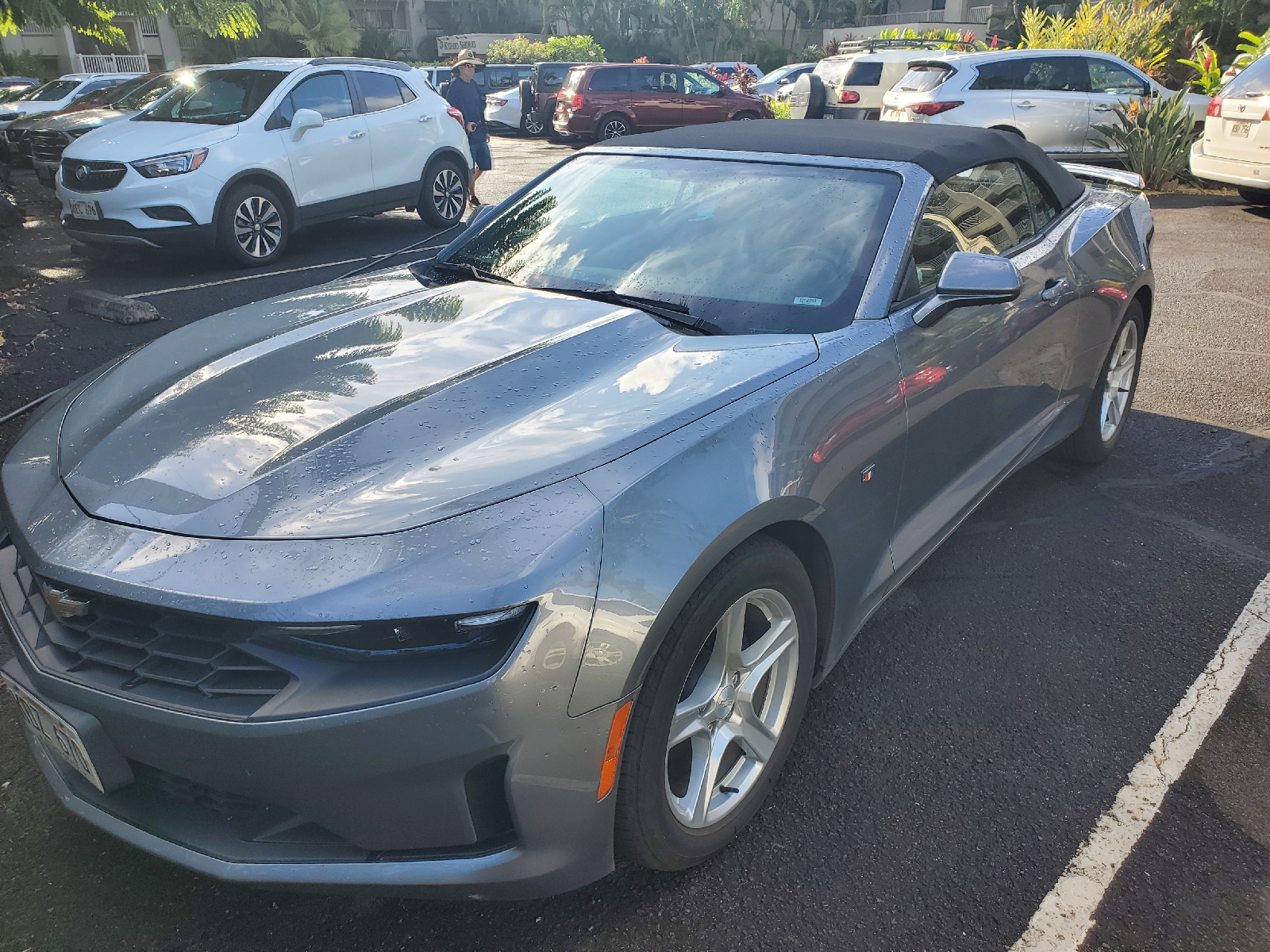
Seemed fun, right? It was a late-model Camaro (I'm not a car guy. Late-model means recent, right?) and looked cool. A Camaro convertible! Not exactly Tom Selleck's car in "Magnum P.I.," but still a convertible.

Getting into it, however? Not so easy.

Oh sure, it's easy when you're 20 or 30 and limber. But you have to get so low to get into that car – like doing squats and then moving laterally! And it was a two-door model with a backseat, so it had big, heavy doors.

Mrs. Brad and I spent the first few days shimmying to get into the car, only to find that one foot was stuck in the gap between the door and frame. Mrs. Brad got a bruise on her hip after repeatedly hitting the seatbelt holder while sliding in.

Worse yet, when we finally put the top down (Hey! We've got a convertible! Let's experience it!), we realized we lost most of our trunk space and put our beach chairs, backpack and towels in the backseat with the hope they wouldn't fly away.

The conclusion: There's a reason people our age drive sedans or SUVs. My Prius is easy to get in and out of, which makes it better than a convertible Camaro for me (you know you're old when you discuss how easy it is to get into a car).

This is no gripe. We're privileged that we could travel to Hawaii. We're lucky we could rent a car. Our vacation was a great experience after 18 months of a pandemic.

But things changed over the past 18 months.

My two travel tips for Hawaii:

• Expect things to be different.
• Rent a sensible car!

Reach Brad Stanhope at bradstanhope@outlook.com.
Monday, September 27, 2021

Crossword puzzles leave me clueless and frustrated

I like words. I've spent most of my adult life as a writer of one sort or another (mostly "another") and often make fun of famous people who misuse words. I'm a snob in that way, although mostly secretly (because I know that publicly making fun of someone's grammar or word use guarantees that I will make a mistake).

I should be a fan of crossword puzzles.

I'm not.

They make me mad, in the same way a 5-year-old gets mad: "It's not fair. It's stupid. They're cheating!"

Shortly before the pandemic began, Mrs. Brad and I made a change in our nightly ritual. Instead of watching TV, we'd do something else at about 9 p.m. We'd go into our office (really, the second bedroom at our swank residential compound) and she'd do a hobby (paint, build tiny rooms) and I would either write or try puzzles.

Emphasis on try.

I'm not a puzzle fan, but I figured I could become one. How hard can puzzles be? I read "Highlights" as a child in doctors' waiting rooms. I can spot the differences in two drawings, I can solve a maze that's designed for 6-year-olds, so I should be able to do Sudoku and crosswords.

Turns out Sudoku isn't that hard. The more difficult puzzles are very hard, but the easy and medium-difficulty ones? I can at least attempt them. Sudoku is an elimination puzzle. You can usually figure things out if you just keep trying and eliminating possibilities.

It turns out crossword puzzles are just as hard as I remembered them being. Because of the blasted puzzle makers.

People who put together crossword puzzles have two major problems:

  • They give clues that have multiple answers.
  • They give clues that no normal person could solve.

I can figure out most clues that don't fall into those categories. But invariably, I run into the second or third clue in a crossword puzzle and it's something like this: "A five-letter word for fast."

What the heck? A five-letter word for "fast?" Maybe swift? Quick? Rapid? Speed? Fasty?

Those types of clues just make me mad. I'm allowed to be sloppy – I commonly make grammar errors and misspell words and expect grace from readers. But the people who put together crossword puzzles and school tests should be exact, right?

Right?

Anyway, those are the clues that have too many answers. The other frequent irritating crossword puzzle clue is the clue that no normal person could solve.

Invariably, a crossword puzzle will have a clue like, "The mythical river credited with the founding of Glasgow." "Or, "Tippi Hedren's beau in 'The Harrad Experiment.'" Or, "Third-most-popular character in written Mandarin."

I could see how someone could know one of those things. Maybe a Scottish historian or movie buff or Chinese language expert. But who knows all of them? Who knows two of them?

When these clues invariably occur, I just get mad. "Who does these puzzles?" I ask Mrs. Brad, who looks up from her painting with a patient smile. "Some sort of wizard?"

By then, I'm just mad.

Of course, there is the occasional payoff if I stick with it and keep trying the puzzles. Eventually, there's a clue I know. Sometimes, it's not even easy.

Maybe it's: Warriors last All-Star before David Lee (Sprewell) or Philly Group that Sang "Love Train" (OJays).

Or maybe it's this: Better puzzle than crossword (Sudoku or Highlights maze).

Reach Brad Stanhope at bradstanhope@outlook.com.