Monday, October 25, 2021

Is Toy Hall of Fame Dream a sandcastle in the sky?

Is this finally sand's year?

That's the biggest question to be answered Nov. 4 when the National Toy Hall of Fame announces the three new members of the most important hall of fame in the world.

Sand is among 12 finalists for induction into the National Toy Hall of Fame, where it hopes to join the similarly overlooked stick, which was inducted in 2008. Other simple toys include blanket (2011), cardboard box (2005), ball (2009)  and paper airplane (2017).

Sand, of course, is a longshot for the Class of 2021. There are just three spots available and most observers expect Cabbage Patch Kids to get one. With American Girl Dolls and Battleship among the other nominees, sand will need to pick up a gritty win to advance, if you get my joke.

The Toy Hall of Fame, for the unfamiliar, is based in Rochester, New York. The Hall of Fame began inducting toys in 1998 with the legendary class that included Barbie, Lego, marbles, Hula Hoop, Lincoln Logs and 12 others. Since that, the greatest class is generally considered to be 2004, when G.I Joe, rocking horse and Scrabble were inducted.

Last year saw Baby Nancy, sidewalk chalk and Jenga qualify. (If only there were a metaphor for the possibility of Jenga's induction collapsing.)

This year's nominees include the aforementioned sand, Cabbage Patch Kids, American Girl Dolls and Battleship. The other eight nominees are billiards, Fisher-Price Corn Popper, Mahjong, Masters of the Universe action figures, piñata, Risk, The Settlers of Catan board game and toy fire engine.

As with every Hall of Fame (baseball, football, basketball,  hockey, rock and roll, inventor, etc.), there is harsh debate over the nominees. You may play Mahjong and think it should be a slam-dunk inductee and I may think it's an adult gambling game, nowhere near the level of the Big Wheel (inducted in 2009) and Silly Putty (2001).

You may consider the Masters of the Universe action figures the epitome of cool toys and I may think they're some dumb toy that arrived, thrived and disappeared between my childhood and that of my kids.

You may think the piñata is a novelty birthday event and I may know you're wrong and it's a brilliant combination of violence, competition and free candy.

You may think that sand is just an irritant that gets on your blanket at the beach and I may think "Oh, it's Mrs. Brad weighing in," but I would still think you're off base.

This should be sand's year. Just read the description of sand as a toy that was included in the Toy Hall of Fame's nomination announcement:  "Sand may be the most universal and oldest toy in the world. Educator Maria Montessori has argued that sand 'is one substance that the modern child is allowed to handle quite freely.' Children recognize sand as a creative material suitable for pouring, scooping, sieving, raking and measuring. Wet sand is even better, ready for kids to construct, shape and sculpt. Sand provides unique opportunities for tactical, physical, cooperative, creative and independent free play."

It's sand's time. Piñata, too, frankly. If they both make it, I'm willing to look past the inevitable Cabbage Patch Kids induction and consider the 2021 class the best in years.

If it's Mahjong and the Masters of the Universe? I'll find you and kick sand in your face. If sand is not a Hall of Fame toy, it's at least an elite-level way to express anger.

Reach Brad Stanhope at bradstanhope@outlook.com.

Monday, October 18, 2021

Cryptocurrency hamster shows the market is a little bit(coin) crazy


Does anyone really understand cryptocurrencies? Not me.

I don't get Bitcoin, Ethereum, Tether, Cardano and Solana.

(The previous paragraph may be a list of cryptocurrencies or a San Francisco-based international law firm. You make the call.)

I'm lost and, frankly, angry. These discussions confuse me and when I'm confused, I get angry.

See what you've done?

Here's all I know: People who are fully into cryptocurrencies – those who say it's the wave of the future and you'll be sorry you sat this one out – will say the same thing about something else in 10 years as they stack their cryptocurrency next to their beanie babies. They're the spiritual descendants of people who insist you should buy gold because the stock market is going to crash. Or those who plan to live off the grid. Or those who say the Sacramento Kings will make the playoffs.

Maybe they'll be right. History says they won't be.

Unless they are.

The real problem for me is that people who trade in cryptocurrencies are sure they're smarter than you and me, because they've seen the future and it's . . . umm . . . well, never mind. Because describing how the future looks to them would require me to describe cryptocurrencies, which I can't.

Back to the problem: Cryptocurrency investors are so sure they're right that they're smarmy about it. Which is why I'm a fan of Mr. Goxx.

Yes. Mr. Goxx.

Mr. Goxx is a hamster who has been "trading" cryptocurrencies since the start of the summer, with the help of two German guys in their 30s. Mr. Goxx lives in a cage and makes a daily decision on which cryptocurrency to invest in by a simple method: He runs on a hamster wheel until he stops and an arrow on the wheel points at a certain cryptocurrency – like on "Wheel of Fortune." Then Mr. Goxx goes into one of two tunnels. One indicates he wants to buy, the other to sell. (His desires may have nothing to do with economics.)

From the time he began investing in June through early this past week, Mr. Goxx's investments had grown nearly 20% – better than the general market, better than most other platforms.

Oh, there are plenty of reasons to dismiss his success: Small sample size. Luck. The vagaries of the market. The inherent ability of hamsters to understand cryptocurrencies.

But here's what I really know: Mr. Goxx's success takes people like me off the hook, because he lets us sneer at slicksters who tell us the world will soon be run on cryptocurrencies.

Cryptocurrencies are ridiculous. They're a scam. And I'll believe that until the day I'm standing outside a grocery store, asking if I can trade all my dollars for one freakacoin, only to discover that the freakacoin lost half its value in the previous day and that I still paid 10 times what it was worth. Then I'll use my money to start a fire to cook a hot dog I found in the gutter.

At that point, I'll regret failing to have Mr. Goxx handle my finances.

I will also regret not hiring Bitcoin, Ethereum, Tether, Cardano and Solana to represent me in court against a lawsuit from Big Cryptocurrency.

Reach Brad Stanhope at bradstanhope@outlook.com.

Monday, October 11, 2021

Period of trouble has created series of brilliant excuses

If the past 18 months have brought plenty of misery (hint: they have!), they also have brought to mind a saying credited to Winston Churchill: "Never let a good crisis go to waste."

That's not to suggest using a pandemic to make money or make political hay (although both have certainly happened). My suggestion is simpler.

The past year and a half has created three new outstanding excuses that we can use. These either didn't exist or weren't widely used before March 2020.

Now? We can use them all the time.

Example One: Covid.

This is the most obvious. You don't have to be at risk of getting Covid-19 to use it as an excuse. In the post-pandemic world (I don't mean the pandemic is over. I mean the start of the pandemic is over), you can opt-out of almost anything due to Covid.

For instance: You forget your sister's birthday and get called out about it. Those calling you out not only called on her birthday but also dropped off a present and hired a band to serenade her while keeping socially distant. Seems like you might be in trouble, right? How could you use Covid as an excuse?

Simple: "Sorry I missed your birthday. I just don't think it's appropriate to celebrate in the midst of a pandemic. Maybe later." Double points, since you made an excuse and you set yourself up as superior, despite forgetting your sister's birthday.

Example Two: HIPAA rights.

Many famous people – particularly athletes – have claimed that it would violate their HIPAA rights to talk about whether they are vaccinated against Covid. Of course, HIPAA's biggest benefit was the ability to continue health insurance after leaving a job, but we mostly associate it with privacy. Key note: HIPAA's privacy guidelines generally apply to medical care providers and insurance, with some extended protection (often to an employer, for instance). Still? A good excuse.

For instance: Your spouse is reviewing the monthly bills and wants to know why you spent $150 on an Amazon purchase that was delivered to your office. The two of you agreed to a budget and this wasn't included. She asks what you bought.

Simple: "I'd love to tell you, but that information would violate my HIPAA rights." When pressed, insist that even discussing it may be a HIPAA violation and you'd prefer to keep that private.

Example Three: Supply chain issue.

This is the issue du jour in American commerce, a combination of ports being backed up, supply shortages and dislocations (whatever that means). We're being told it will drive up prices and cause a crunch for the holidays. How do you use this as an excuse?

For instance: Let's say you've volunteered to do the laundry or mow the lawn or vacuum every week and your roommate wants to know when you're going to do so. You promised, after all.

Simple: "That's complicated, but essentially it's a supply chain issue. I'd love to vacuum, but you know . . . all the dislocations. Things are backed up." If pushed, you come back with the old double-whammy: "I don't feel like it's safe to vacuum, due to the pandemic. And to discuss it anymore would be a violation of my HIPAA rights."

By the way, if you don't like this column, sorry. There would have been a different one, but there were supply chain issues.

Reach Brad Stanhope at bradstanhope@outlook.com.

Monday, October 4, 2021

Visit to Hawaii teaches lesson on pandemic – and sports cars

Mrs. Brad and I took our first substantial vacation in mid-September since the start of the pandemic, spending 12 days in lovely Hawaii.

We learned two lessons:

• Things are very different after 18 months of Covid-19.
• Things are very different after 30 years of not driving sports cars.

First, the effect of Covid.

We visited Kauai, the northernmost of the Hawaiian islands. It wasn't our first visit, so we knew what to expect, but this was different.

Kauai was still beautiful. It was still a great place to hike and go to the beach and hang out at a condo. It was 85 degrees virtually every day and about 77 degrees every night. There was light rain every day. People still drove about 20 mph on the highway. There were still great sundowns.

But retail businesses and restaurants? Very different.

It was obvious the first time we went to a nearby outdoor mall. Masks were required, even outside. About one-third of the stores were closed. Few people were there.

This was significantly different from previous visits.

Restaurants were struggling: Some were closed, others were shut down two days a week, due to labor shortages. Others were understaffed, so it took a long time to get food. That wasn't terrible – we were in Hawaii, so we weren't rushed – but it was noticeable.

Same with retail. Most stores were understocked and many stores limited how many people could go inside, like early in the pandemic in California.

The conclusion: Kauai changed. Hawaii changed. I guess that's no surprise since life changed since March 2020 in Fairfield and Vacaville and Los Angeles and Reno and Cleveland and Buffalo. Why wouldn't it change in Hawaii?

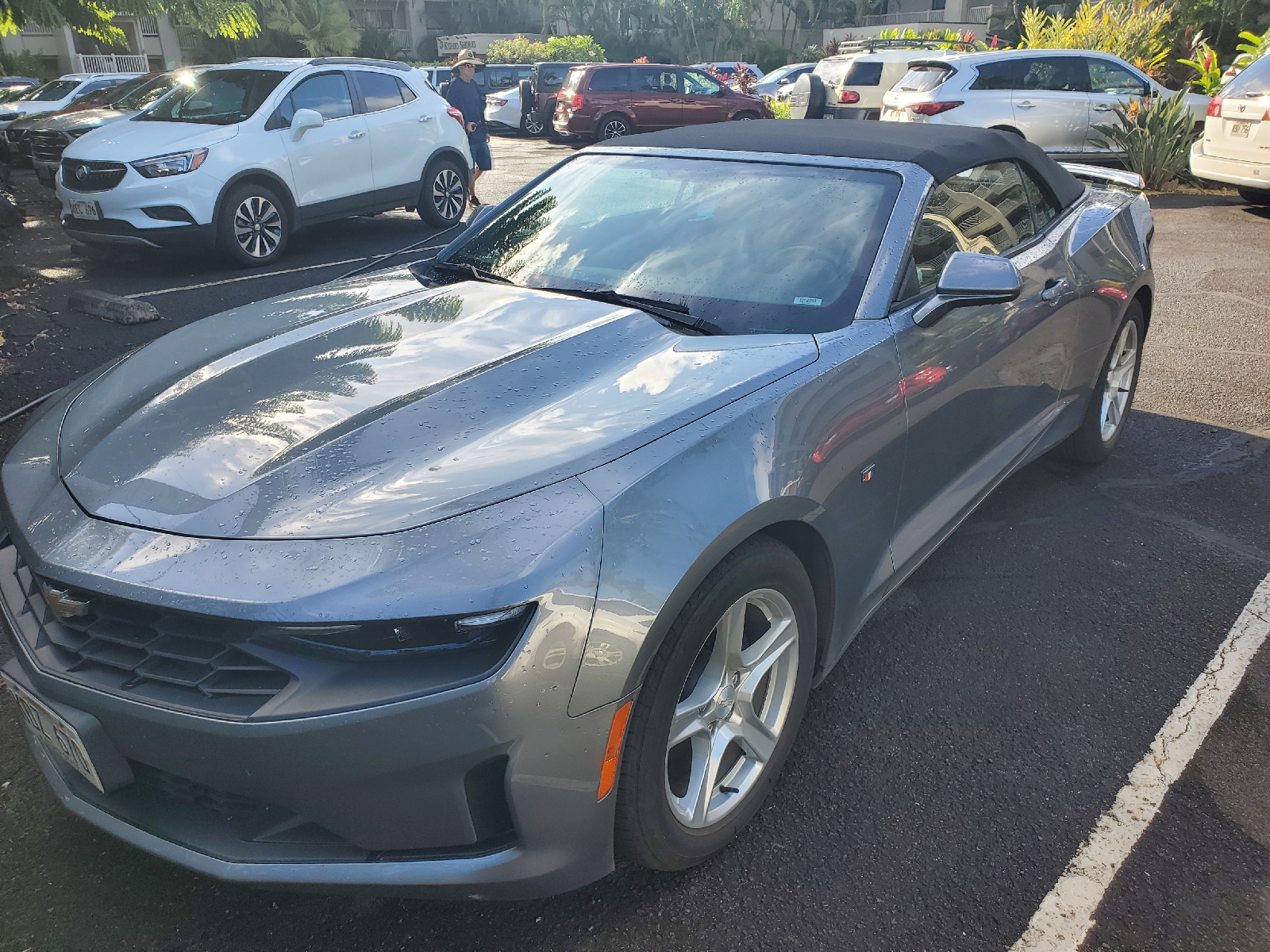
The second lesson was more personal and came after we agreed to rent a convertible.

Seemed fun, right? It was a late-model Camaro (I'm not a car guy. Late-model means recent, right?) and looked cool. A Camaro convertible! Not exactly Tom Selleck's car in "Magnum P.I.," but still a convertible.

Getting into it, however? Not so easy.

Oh sure, it's easy when you're 20 or 30 and limber. But you have to get so low to get into that car – like doing squats and then moving laterally! And it was a two-door model with a backseat, so it had big, heavy doors.

Mrs. Brad and I spent the first few days shimmying to get into the car, only to find that one foot was stuck in the gap between the door and frame. Mrs. Brad got a bruise on her hip after repeatedly hitting the seatbelt holder while sliding in.

Worse yet, when we finally put the top down (Hey! We've got a convertible! Let's experience it!), we realized we lost most of our trunk space and put our beach chairs, backpack and towels in the backseat with the hope they wouldn't fly away.

The conclusion: There's a reason people our age drive sedans or SUVs. My Prius is easy to get in and out of, which makes it better than a convertible Camaro for me (you know you're old when you discuss how easy it is to get into a car).

This is no gripe. We're privileged that we could travel to Hawaii. We're lucky we could rent a car. Our vacation was a great experience after 18 months of a pandemic.

But things changed over the past 18 months.

My two travel tips for Hawaii:

• Expect things to be different.
• Rent a sensible car!

Reach Brad Stanhope at bradstanhope@outlook.com.
Monday, September 27, 2021

Crossword puzzles leave me clueless and frustrated

I like words. I've spent most of my adult life as a writer of one sort or another (mostly "another") and often make fun of famous people who misuse words. I'm a snob in that way, although mostly secretly (because I know that publicly making fun of someone's grammar or word use guarantees that I will make a mistake).

I should be a fan of crossword puzzles.

I'm not.

They make me mad, in the same way a 5-year-old gets mad: "It's not fair. It's stupid. They're cheating!"

Shortly before the pandemic began, Mrs. Brad and I made a change in our nightly ritual. Instead of watching TV, we'd do something else at about 9 p.m. We'd go into our office (really, the second bedroom at our swank residential compound) and she'd do a hobby (paint, build tiny rooms) and I would either write or try puzzles.

Emphasis on try.

I'm not a puzzle fan, but I figured I could become one. How hard can puzzles be? I read "Highlights" as a child in doctors' waiting rooms. I can spot the differences in two drawings, I can solve a maze that's designed for 6-year-olds, so I should be able to do Sudoku and crosswords.

Turns out Sudoku isn't that hard. The more difficult puzzles are very hard, but the easy and medium-difficulty ones? I can at least attempt them. Sudoku is an elimination puzzle. You can usually figure things out if you just keep trying and eliminating possibilities.

It turns out crossword puzzles are just as hard as I remembered them being. Because of the blasted puzzle makers.

People who put together crossword puzzles have two major problems:

  • They give clues that have multiple answers.
  • They give clues that no normal person could solve.

I can figure out most clues that don't fall into those categories. But invariably, I run into the second or third clue in a crossword puzzle and it's something like this: "A five-letter word for fast."

What the heck? A five-letter word for "fast?" Maybe swift? Quick? Rapid? Speed? Fasty?

Those types of clues just make me mad. I'm allowed to be sloppy – I commonly make grammar errors and misspell words and expect grace from readers. But the people who put together crossword puzzles and school tests should be exact, right?

Right?

Anyway, those are the clues that have too many answers. The other frequent irritating crossword puzzle clue is the clue that no normal person could solve.

Invariably, a crossword puzzle will have a clue like, "The mythical river credited with the founding of Glasgow." "Or, "Tippi Hedren's beau in 'The Harrad Experiment.'" Or, "Third-most-popular character in written Mandarin."

I could see how someone could know one of those things. Maybe a Scottish historian or movie buff or Chinese language expert. But who knows all of them? Who knows two of them?

When these clues invariably occur, I just get mad. "Who does these puzzles?" I ask Mrs. Brad, who looks up from her painting with a patient smile. "Some sort of wizard?"

By then, I'm just mad.

Of course, there is the occasional payoff if I stick with it and keep trying the puzzles. Eventually, there's a clue I know. Sometimes, it's not even easy.

Maybe it's: Warriors last All-Star before David Lee (Sprewell) or Philly Group that Sang "Love Train" (OJays).

Or maybe it's this: Better puzzle than crossword (Sudoku or Highlights maze).

Reach Brad Stanhope at bradstanhope@outlook.com.

Monday, September 20, 2021

Facebook data reveals users' preferences, company's agenda

Take a guess at the most-viewed link shared on Facebook during the second quarter of 2021 (April through June).

Nope. Wrong. Guess again.

Nope. Still wrong.

In a world of COVID conspiracy theories, vaccine arguments, political hostility and Tik-Tok videos, the most-viewed link on Facebook during those three months was a website that allows Green Bay Packers fans to pay for interaction with former Packers.

That's true. At least according to a report released by Facebook in August.

I guess it makes sense. Who wouldn't want to go miniature golfing with Ahman Green and Al Harris? Or mountain biking with Brett Favre and the late Vince Lombardi ("Cycling isn't everything. It's the only thing")?

The Facebook report purported to provide insight into what gets the most attention on social media.

One of Facebook's big takeaways was that no single item gets tremendous attention. The top 20 links combined made up less than one-tenth of 1% of all page views on Facebook during that period.

The rest of the top five provides a view of how weirdly diverse our tastes are: Second was a hemp website, third was the site to give to UNICEF to help fight COVID in India, fourth was a food blogger website called My Incredible Recipes and fifth was a Christian apparel website.

Those are links. The most-seen post was the one with a bunch of letters on the screen with an explanation that the first three words you see "are your reality" (yours would be: Reading Dumb Column). Other most-seen posts include one telling you to post a photo that makes you look young, one with questions about what you would never eat and one asking whether sugar goes on spaghetti. Important stuff. If you spend much time on Facebook, you've probably seen many of the most-viewed posts.

Facebook emphasized the same thing with the most-seen posts: That the top 20 combined to make up less than one-tenth of 1% of page views. The implication (that they want us to draw) is that most of us spend most of our social media time seeing friends' posts and photos.

That's kind of true. But also very, very untrue, because of what Facebook didn't do: Report how often people posted similar information. Often misleading information. Sometimes harmful information.

Curiously, about a week after releasing the report for the second quarter, Facebook finally released a report for the first quarter of 2020 – a report it earlier shelved for reasons that were apparent: The most-viewed link from the first quarter was about a doctor who died after a COVID vaccine (later reports showed the vaccine wasn't connected to his death. Alas, the later reports didn't get seen). That single post played a major role in spreading misinformation about the COVID vaccine. Again, not seen by most people, but still significant. It was better for Facebook to highlight the Packers' website, right?

Most importantly, Facebook didn't report what similar information was shared. Just on the specific links and posts. In that way, the reports are kind of useless.

Social media is an echo chamber, where people hear things and share them without checking. Pretty soon, something is so widely viewed that it doesn't matter that it's false. People believe it.

I don't know the solution to that problem and I don't know the specifics of how Facebook could gather information on information that is shared. But the fact that Facebook tailors advertising specifically to your posts indicates the company is capable of doing better.

Reach Brad Stanhope at bradstanhope@outlook.com.

Monday, September 13, 2021

Workweek survey shows youngest workers are insane


There's only one reasonable interpretation of a recent survey of the type of workweek Americans desire: Millennials and members of Generation Z are foolish.

If not the only conclusion, it's at least that's the most obvious conclusion from a recent survey by data intelligence company Morning Consult, which found that 10% of each of those generations would prefer to work five hours per day, seven days a week.

Five hours per day, every day. That's right, they apparently don't want any days off if it means they can work less than six hours per day.

Madness!

Also, it's likely the opinion of people who have never had to work seven or 10 or 15 consecutive days, due to short staffing or multiple co-workers being on vacation.

Before we go further, consider what you would prefer: Given the choice of three 13-plus-hour days, four 10-hour days, five eight-hour days, six six-plus-hour days or seven five-plus-hour days, which would you pick?

Jam all your work shifts together? Spread them out over seven days? Stay with the five-day workweek and traditional two-day weekend?

Here's what the survey indicated: A plurality of people prefers a four-day, 10-hour workweek. That opinion is far from universal, as some demographics prefer the five-day, eight-hour workday (men, millennials and urbanites all rank that option first), but it's fairly popular. Among more than 1,000 working adults surveyed, 40% prefer a four-day workweek and 35% would choose a five-day week.

However, consider the big picture: Nearly two-thirds of those surveyed would prefer something other than the traditional workweek (although four 10-hour shifts it the most popular alternative). Unsurprisingly, the generation with the least amount of variety is baby boomers: 89% of us would take either a four- or five-day workweek.

It's the outliers who are most interesting: The people who would prefer to work three 13.3-hour days a week or seven, 5.7-hour days a week.

The amount of interest in the three-day, 13.3-hour workweek (other than from baby boomers) is fairly steady across generations, geographies and genders at between 5% and 10%. I can understand those people, who consider the value of a four-day weekend. I suspect many of them have never had to work back-to-back shifts of 12 hours or more, so the idea seems pleasant. The reality isn't pleasant: If you have to work that schedule it feels like all you do is work and sleep.

However, that option makes more sense than those we discussed at the start: People who would prefer to work every day (Every. Single. Day. That means Sunday, Monday, Tuesday, Wednesday, Thursday, Friday, Saturday, Sunday, Monday . . . ). Supporters of that schedule include 12% of urban dwellers and 9% of rural residents. I can understand the latter if they're farmers. Seven days of only 5.7 hours would be a break, right?

But the fact that one of 10 millennials and Gen Z members would choose to work every single day (again, that's Sunday, Monday, Tuesday . . .) indicates one of two things: Either they haven't considered what it would be like to never have a day off or they plan to call in sick twice a week.

I guess the problem would be to decide when to call in sick? I suggest Saturday and Sunday. You know, the weekend.

Reach Brad Stanhope at bradstanhope@outlook.com.

Monday, September 6, 2021

NFL's return this week highlights sport's power in America

America's undisputed most popular TV show is back this week. So is America's most popular sport.

They are the same thing: The NFL.

Just a few years after we learned conclusively that many former players suffered brain injuries due to the sport, the NFL has a stronger hold than ever on American sports fans and it's not even close.

When asked in a recent survey, 37% of Americans said football was their favorite sport, more than double baseball, which was second.

TV ratings show an even more dramatic edge. When it comes to getting viewers, the NFL dominates other sports in America like the Bears dominated the then-Redskins in the 1940 NFL championship game: Chicago 73, Washington 0 (hey! NFL trivia!).

To wit:

Among the 25 most-watched TV shows so far this year, 15 are NFL games (Key point: only the final week of the 2020 season and 13 playoff games were played in 2021).  In fact, 14 of the 15 most-watched shows were NFL games (the exception: President Biden's inauguration, which came in sixth, just ahead of an AFC wild-card playoff game).

The Super Bowl dominates TV viewership in 2021, just like every year. But every NFL playoff game made the top 25 most-watched shows. Heck, two regular-season games made the list (and more would have, except as mentioned, there was only the one week of the regular season in 2021).

Further proof of how football dominates TV ratings: In addition to the 15 NFL games, the top-25 list of shows for 2021 also includes three college football games.

If you asked me in 2015 or 2016, I would have said that interest in football in 2021 would be on the decline. The increased spotlight on brain trauma suffered by former NFL, college and high school players was obvious. Parents would pull their sons from football in favor of other sports. The energy of most NFL broadcasts (Brash! Dangerous! Spectacular!) would wear thin.

Basketball was coming fast. It was a social media sport – NBA stars are active on Twitter and Instagram, league rumors churn year-round, it's a great TV sport. Soccer was on the way, with European leagues attracting much of the NFL's core audience of young males. Mixed martial arts was growing rapidly, with pay-per-view events airing constantly. Maybe even baseball would come back.

A few years later, the NFL is bigger, badder and more powerful than ever. The next group of TV contracts will set new records – and based on ratings, they should.

It all comes back this week as the Cowboys (America's Team) and the Buccaneers (Super Bowl champions) kick off the season Thursday. The 49ers and Raiders both play Sunday. Tens of millions (hundreds of millions?) of viewers will be glued to their screens, watching the games, tracking their fantasy leagues, enjoying what the league offers..

There's the possibility that, like me, you're not a huge NFL fan. But like many things over the past several years, get used to it.

The NFL is a dominant feature of American life and is gaining steam.

The NFL is king of American sports and culture.

Reach Brad Stanhope at bradstanhope@outlook.com. 

Monday, August 30, 2021

NASA's artificial Mars mission plan sounds awfully familiar

You are qualified for a job advertised by NASA.

NASA is taking applications for four people to live in an artificial Martian habitat for a year. While there, they will conduct spacewalks, have limited communication with home and exist with restricted food and resources. Oh, there will be occasional equipment failures.

Kind of like that period when your toilet paper supply was running low, you walked around the block once a day and you couldn't figure out how to do a video call with family. Except you'll get paid. By NASA.

NASA seeking people for the fall 2022 mission that will be followed by two others – each lasting a year. Three tries.

The initial announcement said NASA is looking for "healthy, motivated U.S. citizens or permanent residents who are non-smokers, age 30 to 55 years old, and proficient in English for effective communication between crew and mission control." The selection of the crew will follow standard NASA criteria for astronauts, which is to say most of us don't qualify.

Candidates are required to have a master’s degree in a STEM field such as engineering, mathematics, or biological, physical or computer science from an accredited institution with at least two years of professional STEM experience or a minimum of one thousand hours piloting an aircraft.

However, that's not rigid. NASA says it may also consider candidates who have completed two years of work toward a doctoral program in STEM, or completed a medical degree, or a test pilot program. (Still, almost none of us qualify). The announcement also said NASA will consider candidates with four years of professional experience, applicants who have completed military officer training or a bachelor's of science degree in a STEM field. One more step down and many of us might qualify.

The four "winners" will live in a house-sized habitat in Houston that is created by a 3-D printer. It's called Mars Dune Alpha and takes up 1,700 square feet in the Johnson Space Center.

Let's step back a moment and consider what's being sought. Those who get the gig will:

  • Live with three other people for a year in a 1,700-square-foot space.
  • Have limited communications with outsiders.
  • Have limited food and resources.

Forget that "qualification" stuff. You're qualified for this! So am I!

This job sound like the past 18  months.

Sure, they want people to do scientific experiments to simulate what will happen on Mars, but didn't we show that we were qualified when we were creating handmade masks and finding replacements for toilet paper? Will NASA acknowledge our experience from we were having to figure out how to keep our kids learning while not going crazy? Do we get credit for our COVID gardens or our "creative projects" we started during the lockdowns?

NASA is still our best and brightest. NASA sent 24 men to the moon and returned them safely. NASA dreams big.

Mars is worth exploring and I'm on board with having people  simulate living on Mars in isolation with very little communication with their friends and family.

We could do this! However, I'm not very interested in doing it and I suspect most of us aren't.

For one thing, most of us don't qualify under NASA's exacting standards.

But the main reason we're not interested is that spending a year in isolation, trying to navigate a dangerous new world where things are difficult, unprecedented and potentially lethal doesn't sound like fun.

It sounds like 2020.

Reach Brad Stanhope at bradstanhope@outlook.com.

Monday, August 23, 2021

The movie-like story behind a 70-year-old electric shaver

Mrs. Brad and I drove to our hometown a few weeks ago to visit my dad. He's 90 and still going relatively strong: He still drives. He watches a lot of golf on TV. He has opinions on sports and politics and pop culture. He has a flip phone. He has a girlfriend.

As we were sitting on the couch in his apartment, Dad suddenly remembered something.

"Do you need a satchel?" he asked me. Quickly trying to remember what a satchel is (a briefcase!) I initially said no, then realized he wanted to give it to me. So of course I need one. I'm sure I could use it someday.

He brought it out, explaining its origin. He received it when he became a manager at Arthur Young & Co., the old accounting firm, in the early 1960s. He got a new leather satchel and a raise, he said. The satchel was in good shape, with some old accounting ledger sheets in it. I took it and smiled. His story made it cooler. Maybe I'll use it.

Then he remembered something else. "Oh, do you want an electric razor? It's my old one."

An electric razor?

My dad brought out an old Norelco plug-in shaver. Cool, right? The story is better.

My dad won the shaver in a poker game. On a ship. Coming back from the Korean War in 1953.

Is there a better story than that behind what's ostensibly an electronic device of the 1950s? Having left his hometown in eastern Montana, my dad joined the Air Force ahead of being drafted into the Army. He spent time in Korea (where he picked up habits that continued into my childhood, including really short showers and a love of Spam) and then came home. At that point, he was in his early 20s and hadn't met my mom. His whole life was ahead of him.

During a poker game on the trip home, one of his fellow passengers ran out of money and offered a Norelco electric razor as collateral. An electric razor! New technology!

My dad won the hand, taking the shaver.

I remember the shaver from my childhood and may have even used it on some of my early shaves. Since it's from the early 1950s, it's not rechargeable. As my dad said, in those days, if something was electric, it was plugged in.

Back at our hotel that day, I plugged it in and it worked. It was sluggish and probably wouldn't be very effective at shaving a beard without a new motor, but it was a SEVENTY-YEAR-OLD electric razor, still trying to do its job.

Before my dad was a 90-year-old living in a senior apartment complex, before being married to my mom and stepmom (both of whom died), before having any kids – heck, before getting a leather satchel for being promoted to manager on his way to being a managing partner of an independent CPA firm – he was like a movie character: A guy coming home on a ship from a foreign war, winning an electric razor in a poker game.

Maybe when I'm 90 I'll pass something like that on to my sons. Except it will be a CD that I burned on my desktop computer or something like that.

Or maybe . . . it will be an electric shaver that my dad won on a transport ship in 1953, coming home from the Korean War.

Reach Brad Stanhope at bradstanhope@outlook.com.