Sunday, February 2, 2025

Talking turkey: How AI may help us understand animal speech

I don't like artificial intelligence language models.

While they're effective for helping people write emails or memos – particularly those who are uncomfortable writing – they create an opportunity for the rapid spread of misinformation. That's because such programs as ChatGPT and Copilot lack human skepticism, which means they often believe anything that appears on the internet. In that, they're like your aunt.

AI language models also threaten people like me: They will increasingly be used to "report" news and write informative reports. That threatens the value of news gathering, which is vital to an informed citizenry. Great reporters and writers can't be replaced by a computer without some loss of value.

However, there is a valuable potential use for such AI language models with a fascinating – albeit suspicious – purpose: Using AI to understand how animals communicate.

Yes. You may someday use AI to understand what your dog or cat says. You may be able to understand a mouse in your wall or a fly that's buzzing in front of your TV screen.

A company called Earth Species Project has an AI language model called NatureLM that it claims can already identify the species of an animal that's "speaking," determine the animal's approximate age and identify whether it's in distress or playing.

The language model is trained by human language, environmental sounds and other data. Earth Species Project recently announced that it had received nearly $20 million in grant funding. 

According to an article on Axios, researchers already know that birds make different sounds while singing songs (most often "Freebird" or "When Doves Cry") and sounding a warning call. Researchers also say that many species have individual names for one another (most common names among ants: Ant and Bugsy) and some, like prairie dogs, have a system of nouns and adjectives to describe predators ("big ugly squealer" for coyotes).

Today's treat for Daily Republic readers: I came into possession of a bootleg version of NatureLM, recorded animals near me and will share what I heard.

A neighbor's dog, on a walk: "Heya, heya, heya. Wanna play? Wanna play? Heya, heya, heya."

Two wild turkeys, in my neighborhood: "Hey Larry, Hey Larry! Hey! Check me out! I'm gonna fly!"

"Knock it off Scott. Let's go over–

"Hey Lar-ree! Lar-ree! I can fly! I could be a goose!"

"Watch out, Scott. There's a car--"

"Hey Lar-ree! I bet I can fly better than you! And check out my tailfeathers!"

A fly, circling my food while I eat outside: "Bzzzzzzzzzzzz. Bzzzzzzzzzzzzzz."

A coyote, between howls: "Hey prairie dogs! Come out and play! Come on out! I'm not a 'big ugly squealer, I'm a owwooooeeeeeeeeeeeeeeeee! That wasn't a squeal, that was a owwoooeeeeeeeeeeeee!"

A neighbor's cat, near the window: You pathetic excuse for a living being, you think you'll learn about me by listening to my conversation? Tell my servant to clean out my litter box. Now. It's not gonna clean itself."

The turkeys, again: "Lar-ree! Lar-ree! Do you think the ladies will like me more if I fly?"

"I don't know Scott. I think you should just keep it do–"

"Lar-ree! You're jealous, right? I don't blame you, look at these feathers!"

"Scott, just settle down."

"Hey Lar-ree! Did you hear what the duck said the other day when he bought lipstick?"

"I don't think ducks can speak."

"He said, 'just put it on my bill. Get it?"

After that discussion, I turned off NatureLM, knowing one thing: Turkeys have an underrated sense of humor.

Reach Brad Stanhope at bradstanhope@outlook.com.

Sunday, January 26, 2025

Beginning of 2025–sleeping in a kitchen chair, ER visit, appreciation for breathing

I knew I was really sick long before I was in the emergency room with concern about congestive heart failure.

The realization came on the fifth or sixth consecutive night sleeping while sitting in a kitchen chair, my head resting on a pillow propped against the kitchen counter. Every night, I woke after a couple of hours with coughing fits that resulted in me gagging.

I began 2025 with the worst illness of my life. While I don't generally write about my health (Editor's note: Yes, he does. In 2022, he wrote about a cancer diagnosis. In 2023, he wrote about having COVID. He's probably written about being a Type 1 diabetic 100 times), this is worth telling.

It began right before Christmas with a mild cough. Dec. 26, Mrs. Brad and I traveled to Southern California to see our son, daughter-in-law and granddaughters. I was recovering. Then I got a little worse. And a little worse. And worse. We cut the trip short and returned home the Saturday after Christmas. I kept getting worse.

By Sunday night, I was very sick. My cough was so bad that I couldn't lie down. In fact, I couldn't sit in a comfortable chair (such as a living room chair, with a slight tilt back) without developing spastic coughs that resulted in me hugging the toilet and gagging because I was coughing so hard.

I didn't sleep that night. The next day, I saw my doctor, had a chest X-ray to rule out pneumonia and started several prescriptions. Yet I kept coughing until I gagged. Still unable to sleep, I sat on a stool, leaning forward against my pillow. By Tuesday night, I sat in a kitchen chair and began sleeping pitched forward, a few hours at a time.

New Year's week passed in a blur of coughing. I couldn't nap because I couldn't rest. I was awake most of the night. I don't remember much beyond coughing and gagging and staring at the floor and being out of breath after taking 10 steps.

Several times I wondered how long a human can go without sleeping more than two hours a night. Slowly, I got slightly better. Until I didn't. The Sunday after New Year's Day (a week after the first night spent upright), I started to go backward again. Then Mrs. Brad noticed my legs were swollen.

The first Monday of 2025 – a week after I first saw my doctor – I messaged her again to tell her about my legs. Hours later, she finally saw my message and immediately called.

"You need to get to the emergency room," she told me. "This could be a myocardial event."

"I don't know what that means."

She was direct: "I don't mean to scare you, but these are the symptoms of congestive heart failure. You need to get to the emergency room."

Fighting back panic and coughs ("It's probably nothing." "This can't happen to me." "'Failure' seems like an overly dramatic word choice, right?"), Mrs. Brad and I headed across town to a packed ER. Blood work, an EKG, an X-ray and four hours later, we got the good news: I was just very, very sick. A terrible bronchitis. I needed another round of antibiotics, steroids and some other new drugs, including Lasix to stop my leg swelling.

More nights of sleeping upright. It was now 10 nights. Eleven. Twelve. Sitting in a kitchen chair, leaning forward to sleep from midnight until 2:30 a.m. or so, then being awake and perhaps returning to the chair to see if I could fall asleep again. Getting up at 4 a.m. and waiting for the day to start. Relentlessly coughing.

Gradually, the second round of drugs kicked in. By Thursday afternoon (two weeks after we left home for Southern California on the ill-fated trip), I felt better. Thursday night I slept in a recliner for the first time. By Sunday, I could sleep on the couch, with torso and head elevated. Able to rest, my body demanded long naps over that third weekend of being sick.

I was able to go outside and walk a short distance on the 17th day of my sickness. By the time my second round of antibiotics finished (three weeks after I started getting really sick), I was better. Weakened. Still come coughing. But more healthy than sick. More than three weeks into the illness, I slept in a bed for the first time in 2025.

There's no lesson in this, other than our bodies are fragile and if one thing goes wrong, it can be a mess. I spent a lot of time thanking God for things other than my health and pledging to Mrs. Brad that I'd never take breathing for granted again. I probably will, but that's a good goal, right?

Here's to a healthy 2025.

Reach Brad Stanhope at bradstanhope@outlook.com.


Sunday, January 19, 2025

Grocery store study shows need for connection in bananas

Want attention? Act sad, which will make people more likely to choose you.

At least that's the conclusion based on how we treat bananas. Seriously. It's a lesson from bananas–at least that's according to folks at The Conversation, which publishes informative articles by academic experts for the general public.

The Conversation folks found that shoppers, at least, are attracted to sad bananas.

Yes. This is a column about sad bananas.

Let's start with the basics. Bananas are displayed the same way in all grocery stores: In bunches of four, five or six. When we buy bananas, we buy them in bulk, but not too much bulk. Nobody buys a 12-pack of bananas (if such a thing exists) and most of us want at least four to make it seem worthwhile. There's a sweet spot: Enough bananas to make it worth buying and not so much that they'll go bad.

It's more than one. Probably less than seven.

Bananas grow in bunches, like a large family (why do you think the TV show was called "The Brady Bunch?"). At the grocery store, though, bananas sometimes get separated. A banana falls off the bunch or, more likely, someone pulls off a single banana because they want to buy four, not five. 

That results in lone-wolf bananas. You've seen them in the store, apart from the group, isolated. They're like people sitting alone in a restaurant or watching the movies alone. You don't know if they're sad or if that's their choice. But you're reluctant to go sit next to them.

Similarly, we rarely buy a single banana. No, you want a bunch. You want four or five. You don't want Tito Jackson; you want the Jackson 5.

As a result, grocery stores often throw out solo bananas, creating food waste.

There have been efforts to change that. A German grocery store chain sells individual bananas as "singles," perhaps figuring that if people will buy single cans of soda, they'll buy single bananas. It hasn't been particularly successful, but the people at The Conversation came up with a tweak to the single-banana plan that just may work.

They gave the fruit personalities and a story.

With the approval from some grocery stores, The Conversation people separated solo bananas into three groups, putting them in crates with signs above them.

Above one crate, they put an image of a banana with a sad face and a sign that said, "We are sad singles and we want to be bought as well."

Above another, there was a banana with a happy face and a sign that said, "We are happy singles and we want to be bought as well."

Above the third crate, there was no banana face, just a sign that said, "Here are single bananas that want to be bought as well."

What do you think was the result?

If you remember what I wrote earlier, you get an A+. The sad-message bananas sold much faster than the others. People felt bad for the bananas! They wanted to meet the bananas' needs by buying them, taking them home, ripping off their peels and eating them (or maybe people didn't think that all the way through).

Those who conducted the study looked into it further and found the same approach works for tomatoes  (although buying a single tomato seems much more normal than buying a single banana.) The findings match up with studies about how we view humans–that we have an innate desire to assist those who are struggling to connect with others.

It may be the awkward kid you see who just wants to fit in. Or the person you know who really wants friends. Or maybe that banana in the produce section, cast off from his family.

The purpose of the banana study was to evaluate whether there are ways to decrease food waste. A lot of grocery store food gets thrown out and maybe if it were just marketed right, we'd be more interested in a single carrot or a potato or stalk of broccoli.

Bananas are a great fruit. But with this study, perhaps bananas taught us their greatest lesson: That whether it's a fruit or a person, there's something in us that wants to help it connect with others.

People may want to be alone. Bananas may be fine as a solo act. But there's something marvelous that we naturally want to help the "sad bananas" of life make a connection.

Reach Brad Stanhope at bradstanhope@outlook.com.

Sunday, January 12, 2025

Toilet paper equations make no sense in any math style


When I was a kid, adults railed against "new math," which focused on students showing their work and using their deductive skills, rather than simply memorizing formulas.

About 20 years ago, people came out strongly against Common Core math, which focused on . . . um, well, students learning how to think rather than simply memorizing formulas.

These changes are confusing, especially if your math skills come from memorizing the times tables from those charts in the back of Pee-Chee folders.

New math, Common Core, traditional math: Which is best? I'm not sure, but one type of math is harder to understand than any of those.

Toilet paper math.

If you pay attention at the store, you recognize the problem. Look at the toilet paper section and your brain goes fuzzy.

Of course, there are simple packs of four, six or 12 rolls. But then the math comes in.

Some packages say, "18 rolls = 54 rolls," implying that each toilet paper roll is worth three regular rolls. OK, I get that.

But another says, "12 rolls = 42 rolls."

Another says, "18 rolls = 56 rolls."

Another says, "6 rolls = 15 rolls."

What the heck? I know enough about math to know that to solve for x in 6x = y, you divide y by 6 (I've already lost some of you. Hang in there!). If six rolls = 15 rolls, each roll must be worth 2.5 regular rolls. If 18 rolls = 56 rolls, each roll must be worth 3 regular rolls. If 12 rolls = 42 rolls, each roll must be worth . . . let me get my calculator out . . . 3.5 rolls.

(Side point: Suddenly, I'm wondering if "roll" is spelled correctly. It looks wrong. Should it be "role?" No. It's roll. Rollllll. Rooolllllll. Now I can't keep saying it in my brain. Roll.)

Back to the column: At first, I presumed it was simple. If a toilet paper company was advertising that 12 rolls = 24 regular rolls, it considers single-ply toilet paper a "regular roll" and is offering the two-ply variety. Other than the fact that no one buys single-ply toilet paper for their house (I believe it's only used in public restrooms), that made sense . . . until the math didn't work. If "12 rolls = 42 rolls," do they somehow have 3.5-ply toilet paper? What does a half-ply sheet look like? (For that matter, why is it "ply"? And is it really "ply?" Now I'm saying the word "ply" over and over in my brain.)

Perhaps it's not the number of plies, it's the number of sheets. Maybe a "12 rolls = 42 rolls" package of toilet paper has 3.5 times as many sheets. Probably not, because having three times as many sheets would make the roll much, much bigger (more math: the roll gets bigger with more sheets. And more sheets of more ply? And again, what is a ply?)

OK, I looked up ply and still don't really understand the specifics, but it appears that toilet paper only goes to three-ply. Of course, that's what they thought about razors before Gillette started adding more and more blades and now we have (I'm guessing) a shaving kit with 11 blades to make sure you get the smoothest shave possible.

So once you get past a multiplier of three (for instance, "12 rolls = 42 rolls"), it's more sheets, right?

But back to the ply question: Why haven't the big toilet paper manufacturers realized that the best way to add quality is to add a fourth or fifth ply? You could do a five-ply toilet paper with twice as many sheets and you'd be able to have a 12-roll package that is equal to . . . hold on, I'm calculating . . . OK, carry the two . . . 120 rolls! You might not need to get another package for months and months.

Of course, there comes a point where you add so many plies that it becomes a washcloth and you already have those and the thought is disgusting and never mind.

But how about that new math?

Reach Brad Stanhope at bradstanhope@outlook.com.

Sunday, January 5, 2025

An ancient, revolutionary goal to make 2025 a memorable year

Why will we remember this year?

I have a bold proposal, but first, let's set the stage: Today is the first Sunday of a year for which we'll have important memories – because every year creates important memories: Some good, some bad, some silly.

Of course, we tend to remember big news events from the year: For 2024, for instance, it was the felony conviction, attempted assassinations and ultimate return to the presidency of Donald Trump; the explosion of women's basketball; the continued rise of artificial intelligence and the two major hurricanes that hit the Southeastern United States.

But we also remember years personally. The year we graduated from high school. When we got married. When we got divorced. When someone close to us died. When we got promoted. When we were unemployed. When we got cancer. When we bought a house. When we lost our home.

What was your biggest memory from 2024? And for what will 2025 be remembered? 

Back to the big picture, because it connects to the small picture: As a nation, we're entering uncharted territory with the political and social implications of the most recent presidential election and a deeply divided nation. For some of us, that filters down to deeply divided families and neighborhoods.

My best (and most optimistic) guess is that the repercussions won't be as bad as the worst fears of many Americans and not as great as the greatest hopes of many Americans. Because that's how politics and life and social change works. We expect sweeping changes and usually get a compromise and gradual change.

The past few years have been tough and I'm far from alone (on either side of the political spectrum) in decreasing my focus on political news and social media after the election. My life has been fine.

That's a good reminder that national politics are not a priority for most of us. Most of us are busy living our lives and doing jobs, raising kids, coaching teams, doing hobbies and connecting with friends (or wondering why we aren't doing it). We're not spending all of our time thinking about political issues.

However, the past few years saw an increase in scenarios where we find out that someone we like supports a candidate or political party we detest and we feel conflicted. Maybe we start considering them an enemy. We think they're stupid or hateful or naive. We start to believe the worst about them.

We shouldn't. We can hold a vastly different stance on a political issue than me and neither of us is necessarily evil. We just disagree.

So, finally, here's one goal for 2025: Let's make an effort to celebrate what we have in common. Let's make an effort to love others. Let's not assume the worst of people with whom we disagree.

Help someone who makes your life difficult. Spend more time listening with the goal of understanding, rather than devising a counterargument. Interpret the actions of others most graciously, rather than in the most critical way.

The other day, I heard the old Don Henley song, "The Heart of the Matter" and the lyrics apply to 2025:

Ah, these times are so uncertain, there's a yearning undefined and people filled with rage. We all need a little tenderness, how can love survive in such a graceless age?

Here's how: By being gracious. By making 2025 the year we give others the benefit of the doubt. By spending the next 12 months doing good to others regardless of whether we think they "deserve" it.

If that sounds familiar and you want something a little deeper than a 1989 song by the former drummer for the Eagles, consider this:

Jesus said to love our enemies and to pray for those who persecute us. He said to serve others, not to look to be served.

That's a good recipe to make your 2025 better: Grace and servanthood, despite all the craziness elsewhere.

Wouldn't it be remarkable if at the end of 2025, that's what we remembered from our lives? That's my Project 2025.

Reach Brad Stanhope at bradstanhope@outlook.com.


Sunday, December 29, 2024

Survey of why we don't have dream job reveals men are simpletons

Never really getting a shot at your dream job – being the lead singer of a rock band or playing professional sports or being a movie star – isn't your fault. It's the fault of . . . fate? An unfair world? I don't know, but it's not because you lack the skills or motivation to do your dream job.

It's not your fault.

That's one of the conclusions from a survey conducted by Voice Nation that revealed that only 8% of Americans work their dream job. According to the survey, financial barriers, lack of opportunities and personal obligations are among the major factors holding people back.

If it weren't for those (and other) barriers, you'd be on your way to hosting a late-night talk show on network TV or being the radio voice of the San Francisco Giants or playing point guard in the NBA (three of my childhood dream jobs).

The folks who conducted the survey broke down the top five dream jobs by gender for those who answered the survey.

The top five dream jobs for men are entrepreneur (10%), professional athlete (9%), musician or singer (8%), engineer (6%) and pilot (5%).

For women, the top dream jobs are entrepreneur (9%), veterinarian (8%), teacher (7%), doctor (6%) and artist (6%).

The first thing: Men are goofballs. Do 9% of us really think we could be a professional athlete and 8% think we could be a musician or singer? What are we, 7 years old? Women are more reasonable, with all of their "dream jobs" available if you are able to pursue them (and are smart enough). Two of the top three men's dream jobs are fever dream jobs.

Now, the barriers. Here's what we said is keeping us from having our dream jobs, in order. Financial constraints (33%), lack of opportunities (22%), family obligations (20%), fear of failure or lack of self-confidence (18%), health issues (16%). If you're a mathematician (a dream job!), you realize that adds up to more than 100%, so obviously people could choose more than one barrier.

Before going any further, let me talk briefly to the 17% of men whose dream job is professional athlete or musician/singer. Just a hint, that the reason you don't have that job probably isn't because of financial constraints or a lack of opportunity or even family obligations. Here's the real reason: YOU AREN'T GOOD ENOUGH. ALMOST NOBODY IS. THAT'S WHY IT THOSE PEOPLE ARE STARS.

OK. Got it? I'll concede that it's possible someone reading this could have been a professional musician or athlete if not for an obstacle. No, never mind. I won't concede that. It's not true. YOU'RE NOT A PROFESSIONAL ATHLETE OR ROCK STAR OR PROFESSIONAL RAPPER BECAUSE YOU'RE NOT GOOD ENOUGH AT IT!

The point of the survey was to identify dream jobs and examine why we think we don't have them. That's not why we don't have them, it's why we think we don't have them.

We tend to blame outside sources, but let's be real: I'm not a lawyer because it seemed too hard. I'm not the Giants broadcaster because I'm not good enough. I'm not an NBA point guard because I'm too old (that's the only reason. Really.). I'm not a cowboy because I'm afraid of horses. I'm not the host of a late-night TV show because I'm not clever enough nor attractive enough.

I'm not good enough for my dream jobs.

I'm not saying we should all have jobs that suck. I like my job. I loved being a sports editor and newspaper journalist (a dream job of mine). You should pursue what you like – or at least something you can learn to enjoy.

But the idea that we could all have our dream jobs if it just weren't for those pesky family obligations or financial constraints is ridiculous. Most of us don't have our dream job because very, very few people have jobs that we consider dream jobs.

AND GUYS, QUIT THINKING YOU'D BE A PROFESSIONAL ATHLETE OR FAMOUS MUSICIAN IF YOU JUST GOT A FAIR CHANCE. YOU AREN'T GOOD ENOUGH AT IT.

Sorry for bursting your bubble. That's one of my dream jobs, too. Bubble-burster for dumb guys.

Reach Brad Stanhope at bradstanhope@outlook.com.


Sunday, December 22, 2024

Masking? Electrical? Scotch? Ranking the top eight types of tape

As we near the end of Scotch tape season (Christmas, the high holiday for the Scotch tape industry, is Wednesday!), there are two things I've learned:

  • You capitalize "Scotch," even though it was originally a pejorative term. It was used in the 1930s to suggest miserliness: The tape name was inspired by someone complaining that the bosses who manufactured tape were cheap.
  • It's a brand name. Unless it's made by the people at Scotch Brands, the tape we think of as Scotch tape is called cellophane tape.

A third thing: Scotch tape is only the second-best type of tape. It's valuable for wrapping gifts, holding pieces of paper together and even getting lint of clothes, but it's not the best tape type (say that three times fast!).

How are tapes ranked? Good question. The top eight popular variations after three honorable mentions: Tape measures, measuring tape (I didn't realize until this moment how those types of tape have names that are just reverses of each other) and that scourge of elementary school fears, tapeworms.

The top eight:

8. Two-sided tape. This variation of cellophane tape seemed amazing the first time I saw it as a kid. Then I tried to use it and couldn't make it work right. It stuck to my fingers, eyelids and shoes. It's supposedly better than looping Scotch tape with the sticky out, but it isn't. All flash, little usefulness. 

7. Tan masking tape. I differentiate masking tape types. This can be used for painting but is better for taping things on the wall without fear of peeling off paint. Masking tape is also versatile, a good substitute for Scotch tape and and emergency backup for the superior blue masking tape (see below).

6. Electrical tape. The black, shiny tape is very use-specific (to cover and/or insulate cables, wires or other materials that conduct electricity). That makes it valuable, but electrical tape can be used for other things (particularly by kids who can't find duct tape and use electrical tape to, for instance, tape up their bike seat or secure something heavy). 

5. Cassette tape. OK, not an adhesive tape, but it's a type of tape, right? Music on cassette tapes was amazing because it made music portable! You could bring a tape recorder (or boombox or Walkman or whatever you had, depending on the era) and listen to music. You could replace the balky 8-track player (another type of tape that just missed this list) with a mobile player. And "fixing" a tape after it was "eaten" by the player required a pencil, wits and nerves of steel.

4. Packing tape. While I was writing this, Mrs. Brad used packing tape to wrap up something for her business, at one point startling me with the screech of the tape tearing. This is in the same category as electrical tape – a type with a specific use. I don't need it, but if you're shipping something, you do.

3. Blue masking tape. When someone says to "tape off" an area because they're painting, they usually mean to use the blue masking tape. At least I think so. I consider blue the Cadillac of masking tape and the fact that you can use this and then freely paint a wall – and wind up with straight lines – is fantastic.

2. Scotch. Or, of course, cellophane tape. Great for connecting paper, great for holding light-weight things on the walls and most importantly, widely available. You can get this at a drug store, grocery store, business supply store and perhaps even a pizza parlor or bar. I can only assume. We have backups of this because I generally buy three at a time.

1. Duct tape. Two things are true: 99% of us have never used duct tape on a duct, because we don't deal with ducts; also, every home needs to have a roll of duct tape available. It can hold virtually anything in place (or at least that's what we think when we use it), it's fairly easy to use and a roll has a lot of tape on it. I love duct tape, the LeBron James of tape.

Reach Brad Stanhope at bradstanhope@outlook.com.


Sunday, December 15, 2024

How well do you know Solano County? Take this quiz!

We love holiday traditions. Eggnog. Christmas carols on KOIT radio. Forgetting where you parked your car at the mall. "Rudolph, the Red-Nosed Reindeer" on TV. Salvation Army bell ringers at the store.

And the annual Solano County quiz.

I've presented a quiz on the county every December since . . . I don't know, probably 2004? Let's say that. Let's say this year marks the 20th anniversary of the first such quiz!

It's a quiziversary! As always, what follows are 20 questions that reveal how much you know about Solano County. Some are geographical, some are demographical, some are commonsense, some are whimsical (I hope).

Twenty questions, so keep score. The answers follow, so don't look ahead.

QUESTIONS

1. Name the seven Solano County cities.

2. Within 50,000, how many people lived in Solano County in 2023, according to the Census Bureau?

3. What are the five counties that are geographically connected to Solano County?

4. Which city has a larger population, Fairfield, California, or Fairfield, Connecticut?

5. Within 400 miles, what's the distance from Fairfield, California, to Fairfield, Connecticut by road?

6. Who is the county administrator of Solano County?

7. Who was elected president the last time a majority of Solano County voters voted Republican?

8. Name the three members of the House of Representatives who will represent Solano County in the next Congress.

9. Why are "boor," "bore" and "boar" all pronounced the same, while "live" can be pronounced two ways?

10. What was the leading crop (in terms of dollar value) in Solano County in 2023?

11. Within 1,000, what is the combined inmate population (as of Dec. 4, 2024) of the two Vacaville prisons?

12. Within two degrees, what's the highest temperature ever recorded in Vacaville?

13. In terms of student population, what is the largest high school in Solano County?

14. What are the four interstate freeways in Solano County?

15. Who is the namesake of the city of Benicia?

16. In what two Solano County cities are there general aviation airports?

17. What was the name of the bank where Mr. Drysdale worked on "The Beverly Hillbillies?"

18. On average, in what month does Fairfield receive the most rainfall?

19. Which Solano County city has a larger population: Suisun City or Benicia?

20. Which of the following people is not from Vallejo: Raymond Burr, Joey Chestnut, G-Willikers, E-40, B-Legit.

ANSWERS

1. Benicia, Dixon, Fairfield, Rio Vista, Suisun City, Vacaville, Vallejo.

2. 449,218 (You get credit if you guessed 399,218 to 499,218).

3. Contra Costa, Sonoma, Napa, Yolo, Sacramento.

4. As of 2023, Fairfield, California (120,768) had nearly twice as many people as Fairfield, Connecticut (63,433).

5. 2,915 miles (answers from 2,415 to 3,315 considered correct).

6. Bill Emlin.

7. Ronald Reagan (1984).

8. Mike Thompson, Doris Matsui, John Garamendi.

9. Because English is a strange language.

10. Tomatoes, at about $101 million.

11. 5,796 (1,925 at the California Medical Facility, 3,871 at California State Prison, Solano).

12. It reached 115 degrees on Sept. 6, 2022.

13. Rodriguez High School in Fairfield (2,081 students as of 2023, narrowly edging out Vacaville High School).

14. 80, 680, 780, 505.

15. Gen. Mariano Vallejo's wife, Francisca Benicia Carillo de Vallejo.

16.  Rio Vista and Vacaville.

17. The Commerce Bank of Beverly Hills. It's not a Solano County question, but I amused/irritated Mrs. Brad by recently reciting that.

18. December (5.40 inches on average. February is second, January third).

19. Based on 2024 estimates, Suisun City's population of 28,498 is larger than Benicia's 26,203.

20.  I made up "G-Willikers," although it would be a cool nickname for an innocent, gullible rapper.

SCORES

15-20: Genius.

10-14: Pretty smart.

5-9: I'm sure you know something. Right?

0-4: Maybe you just moved here?

Reach Brad Stanhope at bradstanhope@outlook.com.

Sunday, December 8, 2024

Infinite monkey theorem debunked, so a monkey typed my column

The old adage says that if you give typewriters to an infinite number of monkeys and give them enough time, they will eventually re-create the complete works of William Shakespeare.

It's not true – and not just because the monkeys would be outraged that you made them use typewriters. No, the "infinite monkey theorem" – used to describe randomness, probability, Shakespeare and why "The Monkees" was such a popular TV show – is not true because of something more fundamental.

Two mathematicians from Australia (I don't think they're the two guys in Air Supply, but I'm not 100% sure) seemingly disproved the idea. Not because monkeys aren't good at 1500s English or because they would get carpel tunnel syndrome or because Shakespeare's plays are copyrighted. They wouldn't do it because of time.

Maybe "an infinite amount of time" would work. Maybe. But Stephen Woodcock and Jay Falletta (now I'm pretty sure they're not the Air Supply guys) concluded that the time it would take is longer than the lifespan of our universe. So it wouldn't work.

The mathematicians made their calculations based on the idea that the universe will end sometime in the distant future in a way I don't understand but in a way that isn't similar to how life is mentioned in the song "In the Year 2525."

They concluded that if you took every living chimpanzee (about 200,000) and each typed one key per second for the rest of their lives (and their descendants did the same thing), they wouldn't come close to typing Shakespeare's full works.

In fact, it's worse: According to the research, there is only a 5% chance that any monkey would successfully type the word "bananas" in its lifetime. And the chance that one chimp would write a random sentence (such as "Davy Jones and Micky Dolenz weren't really monkeys") is one in 10 million billion billion, which is a lot of zeroes.

So it's very, very unlikely that even if they were given enough time, any monkeys could duplicate the Bard's work. But could they duplicate . . . the Brad's work? (GET IT?)

Seeking to answer whether a monkey could complete even a portion of what I write each week, I went through the website Upwork and hired a chimp named Stanley for one hour (just $25!), gave him a laptop and challenged him to type like me.

He was finished in 45 minutes (Stanley was efficient. I still paid him the entire fee). Here's what he wrote:

mmZZK mmba. Slow ride take it easy. dIIIddk sks. Bananarama. !!@ Everybodywaskungfufighting skjlkdfdd snap crackle pop. dkdkdkdkd tONywaderaidersbAd dds WeTakeOverIn2026.

I didn't see anything close to words there, although you could make the case that "on" is in the middle somewhere.

I've spent much of my life believing the "infinite monkey theorem," although I would mock it by saying there isn't a market for Shakespeare's works and that the monkeys would probably focus more on teen vampire novels. It turns out that monkeys aren't good writers and the real threat to writers is artificial intelligence.

That's too bad. I liked working with Stanley. In fact, as a final treat, I'll let him have the last word in this column.

YouWillBeOurSlavesIn2026.

Hah hah hah. It's sweet that he can't type real words. Just gibberish.

Reach Brad Stanhope at bradstanhope@outlook.com.

Sunday, December 1, 2024

Best Christmas traditions, from hanging lights to movies and more

Thanksgiving is behind us and so is Black Friday. We've already gone beyond Small Business Saturday and Cyber Monday is looming.

It's beginning to look a lot like Christmas!

While the cool kids are cynical about Christmas, saying how they don't like Christmas music or blasting the commercialization of the holiday or the awkward ways businesses navigate around a holiday based on a religious figure, most of us enjoy this time of year.

Part of that is because we have fond memories and fun traditions associated with Christmas.

That's the focus of this column: The best Christmas traditions. Not based on which is most important, but which is most widespread and which brings the most joy. 

There's an honorable mention list, too: Christmas sweaters. Christmas cards. Mistletoe (seems crazy, right?). Egg nog. Add anything that I left off.

But as my mentor Casey Kasem would say, let's start the countdown:

10. Christmas Eve. No pregame show on our holiday calendar equals this. In some ways, Christmas Eve tops Christmas, since it's a daylong buildup of excitement, rather than a morning explosion followed by a day-long reflection. Santa is coming! A holiday is here! What if it snows? Parents (and Santa) are busy wrapping gifts and getting ready.

9. Hanging lights. I separated this from decorating the tree, mostly because can be a hassle and dangerous (how many people make high-risk moves on a ladder to hook one more light over a hook?). Still, putting up lights means the holiday season is in full swing.

8. Leaving cookies for Santa. The final act of Christmas Eve for kids, the plate of cookies (or whatever your tradition) means its bedtime and Santa is about to come. If Christmas were an NFL game, the cookies-for-Santa moment is the last commercial before the opening kickoff.

7. Christmas movies and TV. "Elf." "Miracle on 34th Street." "A Christmas Story." "The Muppets' Christmas Carol." "It's a Wonderful Life." ("Die Hard?"). Of course you can watch these movies year-round, but for the 90% of us who are sane, these movies mark the Christmas season. So do the TV shows: "Rudolph, the Red-Nosed Reindeer," "Frosty the Snowman," "The Grinch Who Stole Christmas." An entire branch of Hollywood is built around Christmas shows.

6. Christmas shopping. Black Friday is the height of Christmas shopping and while an increasing number of us rely on Amazon to bring gifts, this is the magic for many people. City sidewalks, busy sidewalks dressed in holiday style. That's not just "Silver Bells," that's the greatest Christmas moment for many people. And merchants.

5. Driving to see Christmas lights. Candy Cane Lane is a local thing and an every-town thing. In almost every area of the country, there's a place (often called "Candy Cane Lane,") where neighbors decorate their homes, yards, cars and roofs. The rest of us cruise by and gaze in wonder at what they've done. If you live on such a street, thank you.

4. Church services. If you're a regular attendee or someone who attends only at Christmas and Easter, there's something magical about this time of year. The hope of the coming Messiah. The church decorations. The nice people. The sheer number of traditional Christmas carols that are actually Christian hymns.

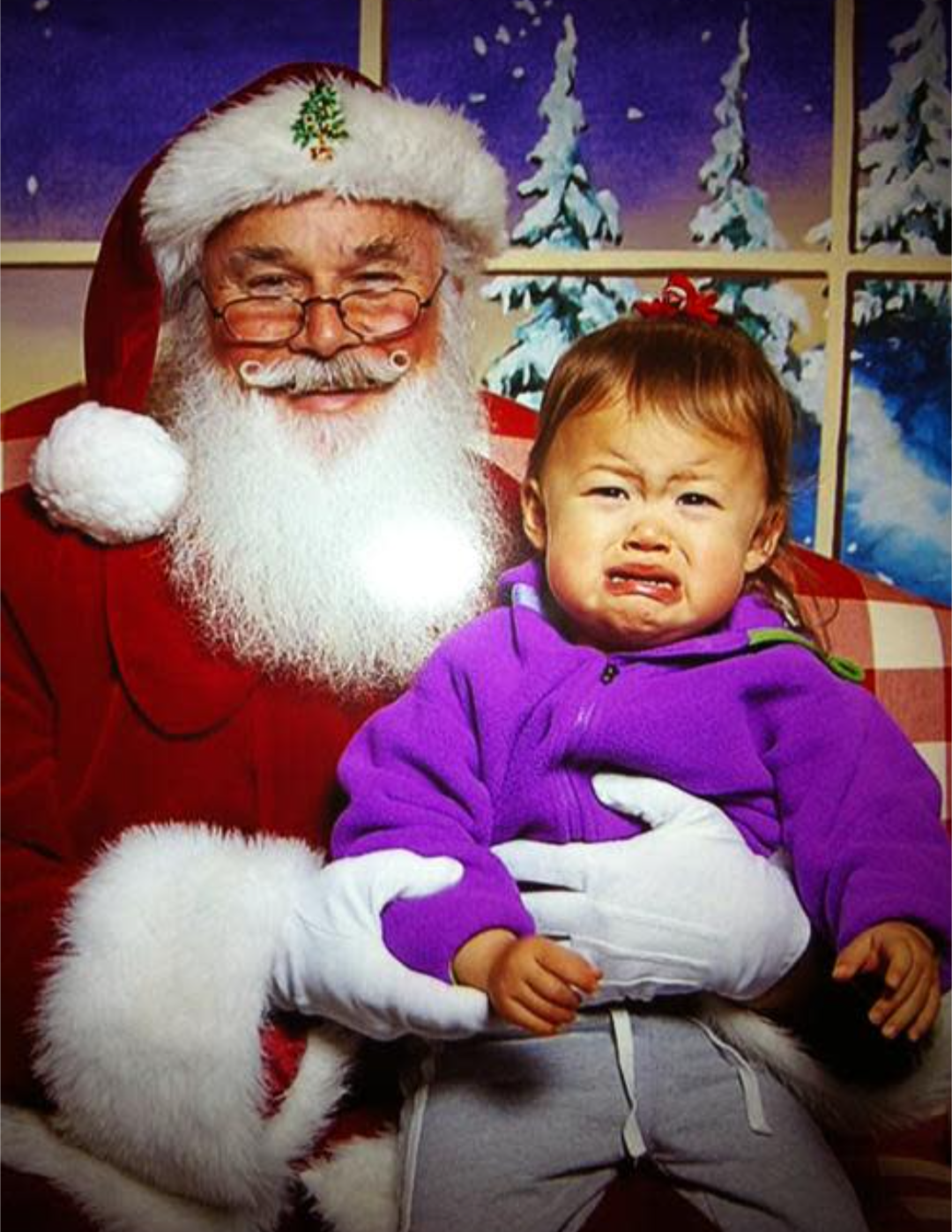
3. Kids meeting Santa. Whether it's sweet or horrifying, this is a classic. The mall Santa or the Santa at the party or the relative who dresses up every year are (virtually) all great. The sweetness of a child's excitement or the panic of the kid who only sees an oversized man in red reaching for them are both tremendous.

2. Decorating the tree. This signifies the official start of the season for most of us. A dramatic decline in real Christmas trees largely removed Step 1 (driving to a Christmas tree lot and paying entirely too much for a tree that doesn't fit in your house), but the rest of decorating – getting out the decorations out, hanging the stockings, listening to Christmas music, finding the remote control that you accidentally packed last year and blamed your spouse for losing – is fantastic.

1. Christmas carols. There is an entire genre of music built around a specific holiday! It's filled with traditional music (how many hymns do you listen to outside of Christmas season?), rhythm-and-blues, pop, country, hip-hop and every other kind of music. Instrumentals. Acapella. Even an over-the-top "American neoclassical new-age music ensemble" like Manheim Steamroller gets a listen. Of all the traditions of Christmas, this is the best because it has the widest impact. Other than the birth of Jesus, I mean.

Enjoy the full holiday season.

Reach Brad Stanhope at Bradstanhope@outlook.com.