Sunday, December 15, 2024

How well do you know Solano County? Take this quiz!

We love holiday traditions. Eggnog. Christmas carols on KOIT radio. Forgetting where you parked your car at the mall. "Rudolph, the Red-Nosed Reindeer" on TV. Salvation Army bell ringers at the store.

And the annual Solano County quiz.

I've presented a quiz on the county every December since . . . I don't know, probably 2004? Let's say that. Let's say this year marks the 20th anniversary of the first such quiz!

It's a quiziversary! As always, what follows are 20 questions that reveal how much you know about Solano County. Some are geographical, some are demographical, some are commonsense, some are whimsical (I hope).

Twenty questions, so keep score. The answers follow, so don't look ahead.

QUESTIONS

1. Name the seven Solano County cities.

2. Within 50,000, how many people lived in Solano County in 2023, according to the Census Bureau?

3. What are the five counties that are geographically connected to Solano County?

4. Which city has a larger population, Fairfield, California, or Fairfield, Connecticut?

5. Within 400 miles, what's the distance from Fairfield, California, to Fairfield, Connecticut by road?

6. Who is the county administrator of Solano County?

7. Who was elected president the last time a majority of Solano County voters voted Republican?

8. Name the three members of the House of Representatives who will represent Solano County in the next Congress.

9. Why are "boor," "bore" and "boar" all pronounced the same, while "live" can be pronounced two ways?

10. What was the leading crop (in terms of dollar value) in Solano County in 2023?

11. Within 1,000, what is the combined inmate population (as of Dec. 4, 2024) of the two Vacaville prisons?

12. Within two degrees, what's the highest temperature ever recorded in Vacaville?

13. In terms of student population, what is the largest high school in Solano County?

14. What are the four interstate freeways in Solano County?

15. Who is the namesake of the city of Benicia?

16. In what two Solano County cities are there general aviation airports?

17. What was the name of the bank where Mr. Drysdale worked on "The Beverly Hillbillies?"

18. On average, in what month does Fairfield receive the most rainfall?

19. Which Solano County city has a larger population: Suisun City or Benicia?

20. Which of the following people is not from Vallejo: Raymond Burr, Joey Chestnut, G-Willikers, E-40, B-Legit.

ANSWERS

1. Benicia, Dixon, Fairfield, Rio Vista, Suisun City, Vacaville, Vallejo.

2. 449,218 (You get credit if you guessed 399,218 to 499,218).

3. Contra Costa, Sonoma, Napa, Yolo, Sacramento.

4. As of 2023, Fairfield, California (120,768) had nearly twice as many people as Fairfield, Connecticut (63,433).

5. 2,915 miles (answers from 2,415 to 3,315 considered correct).

6. Bill Emlin.

7. Ronald Reagan (1984).

8. Mike Thompson, Doris Matsui, John Garamendi.

9. Because English is a strange language.

10. Tomatoes, at about $101 million.

11. 5,796 (1,925 at the California Medical Facility, 3,871 at California State Prison, Solano).

12. It reached 115 degrees on Sept. 6, 2022.

13. Rodriguez High School in Fairfield (2,081 students as of 2023, narrowly edging out Vacaville High School).

14. 80, 680, 780, 505.

15. Gen. Mariano Vallejo's wife, Francisca Benicia Carillo de Vallejo.

16.  Rio Vista and Vacaville.

17. The Commerce Bank of Beverly Hills. It's not a Solano County question, but I amused/irritated Mrs. Brad by recently reciting that.

18. December (5.40 inches on average. February is second, January third).

19. Based on 2024 estimates, Suisun City's population of 28,498 is larger than Benicia's 26,203.

20.  I made up "G-Willikers," although it would be a cool nickname for an innocent, gullible rapper.

SCORES

15-20: Genius.

10-14: Pretty smart.

5-9: I'm sure you know something. Right?

0-4: Maybe you just moved here?

Reach Brad Stanhope at bradstanhope@outlook.com.

Sunday, December 8, 2024

Infinite monkey theorem debunked, so a monkey typed my column

The old adage says that if you give typewriters to an infinite number of monkeys and give them enough time, they will eventually re-create the complete works of William Shakespeare.

It's not true – and not just because the monkeys would be outraged that you made them use typewriters. No, the "infinite monkey theorem" – used to describe randomness, probability, Shakespeare and why "The Monkees" was such a popular TV show – is not true because of something more fundamental.

Two mathematicians from Australia (I don't think they're the two guys in Air Supply, but I'm not 100% sure) seemingly disproved the idea. Not because monkeys aren't good at 1500s English or because they would get carpel tunnel syndrome or because Shakespeare's plays are copyrighted. They wouldn't do it because of time.

Maybe "an infinite amount of time" would work. Maybe. But Stephen Woodcock and Jay Falletta (now I'm pretty sure they're not the Air Supply guys) concluded that the time it would take is longer than the lifespan of our universe. So it wouldn't work.

The mathematicians made their calculations based on the idea that the universe will end sometime in the distant future in a way I don't understand but in a way that isn't similar to how life is mentioned in the song "In the Year 2525."

They concluded that if you took every living chimpanzee (about 200,000) and each typed one key per second for the rest of their lives (and their descendants did the same thing), they wouldn't come close to typing Shakespeare's full works.

In fact, it's worse: According to the research, there is only a 5% chance that any monkey would successfully type the word "bananas" in its lifetime. And the chance that one chimp would write a random sentence (such as "Davy Jones and Micky Dolenz weren't really monkeys") is one in 10 million billion billion, which is a lot of zeroes.

So it's very, very unlikely that even if they were given enough time, any monkeys could duplicate the Bard's work. But could they duplicate . . . the Brad's work? (GET IT?)

Seeking to answer whether a monkey could complete even a portion of what I write each week, I went through the website Upwork and hired a chimp named Stanley for one hour (just $25!), gave him a laptop and challenged him to type like me.

He was finished in 45 minutes (Stanley was efficient. I still paid him the entire fee). Here's what he wrote:

mmZZK mmba. Slow ride take it easy. dIIIddk sks. Bananarama. !!@ Everybodywaskungfufighting skjlkdfdd snap crackle pop. dkdkdkdkd tONywaderaidersbAd dds WeTakeOverIn2026.

I didn't see anything close to words there, although you could make the case that "on" is in the middle somewhere.

I've spent much of my life believing the "infinite monkey theorem," although I would mock it by saying there isn't a market for Shakespeare's works and that the monkeys would probably focus more on teen vampire novels. It turns out that monkeys aren't good writers and the real threat to writers is artificial intelligence.

That's too bad. I liked working with Stanley. In fact, as a final treat, I'll let him have the last word in this column.

YouWillBeOurSlavesIn2026.

Hah hah hah. It's sweet that he can't type real words. Just gibberish.

Reach Brad Stanhope at bradstanhope@outlook.com.

Sunday, December 1, 2024

Best Christmas traditions, from hanging lights to movies and more

Thanksgiving is behind us and so is Black Friday. We've already gone beyond Small Business Saturday and Cyber Monday is looming.

It's beginning to look a lot like Christmas!

While the cool kids are cynical about Christmas, saying how they don't like Christmas music or blasting the commercialization of the holiday or the awkward ways businesses navigate around a holiday based on a religious figure, most of us enjoy this time of year.

Part of that is because we have fond memories and fun traditions associated with Christmas.

That's the focus of this column: The best Christmas traditions. Not based on which is most important, but which is most widespread and which brings the most joy. 

There's an honorable mention list, too: Christmas sweaters. Christmas cards. Mistletoe (seems crazy, right?). Egg nog. Add anything that I left off.

But as my mentor Casey Kasem would say, let's start the countdown:

10. Christmas Eve. No pregame show on our holiday calendar equals this. In some ways, Christmas Eve tops Christmas, since it's a daylong buildup of excitement, rather than a morning explosion followed by a day-long reflection. Santa is coming! A holiday is here! What if it snows? Parents (and Santa) are busy wrapping gifts and getting ready.

9. Hanging lights. I separated this from decorating the tree, mostly because can be a hassle and dangerous (how many people make high-risk moves on a ladder to hook one more light over a hook?). Still, putting up lights means the holiday season is in full swing.

8. Leaving cookies for Santa. The final act of Christmas Eve for kids, the plate of cookies (or whatever your tradition) means its bedtime and Santa is about to come. If Christmas were an NFL game, the cookies-for-Santa moment is the last commercial before the opening kickoff.

7. Christmas movies and TV. "Elf." "Miracle on 34th Street." "A Christmas Story." "The Muppets' Christmas Carol." "It's a Wonderful Life." ("Die Hard?"). Of course you can watch these movies year-round, but for the 90% of us who are sane, these movies mark the Christmas season. So do the TV shows: "Rudolph, the Red-Nosed Reindeer," "Frosty the Snowman," "The Grinch Who Stole Christmas." An entire branch of Hollywood is built around Christmas shows.

6. Christmas shopping. Black Friday is the height of Christmas shopping and while an increasing number of us rely on Amazon to bring gifts, this is the magic for many people. City sidewalks, busy sidewalks dressed in holiday style. That's not just "Silver Bells," that's the greatest Christmas moment for many people. And merchants.

5. Driving to see Christmas lights. Candy Cane Lane is a local thing and an every-town thing. In almost every area of the country, there's a place (often called "Candy Cane Lane,") where neighbors decorate their homes, yards, cars and roofs. The rest of us cruise by and gaze in wonder at what they've done. If you live on such a street, thank you.

4. Church services. If you're a regular attendee or someone who attends only at Christmas and Easter, there's something magical about this time of year. The hope of the coming Messiah. The church decorations. The nice people. The sheer number of traditional Christmas carols that are actually Christian hymns.

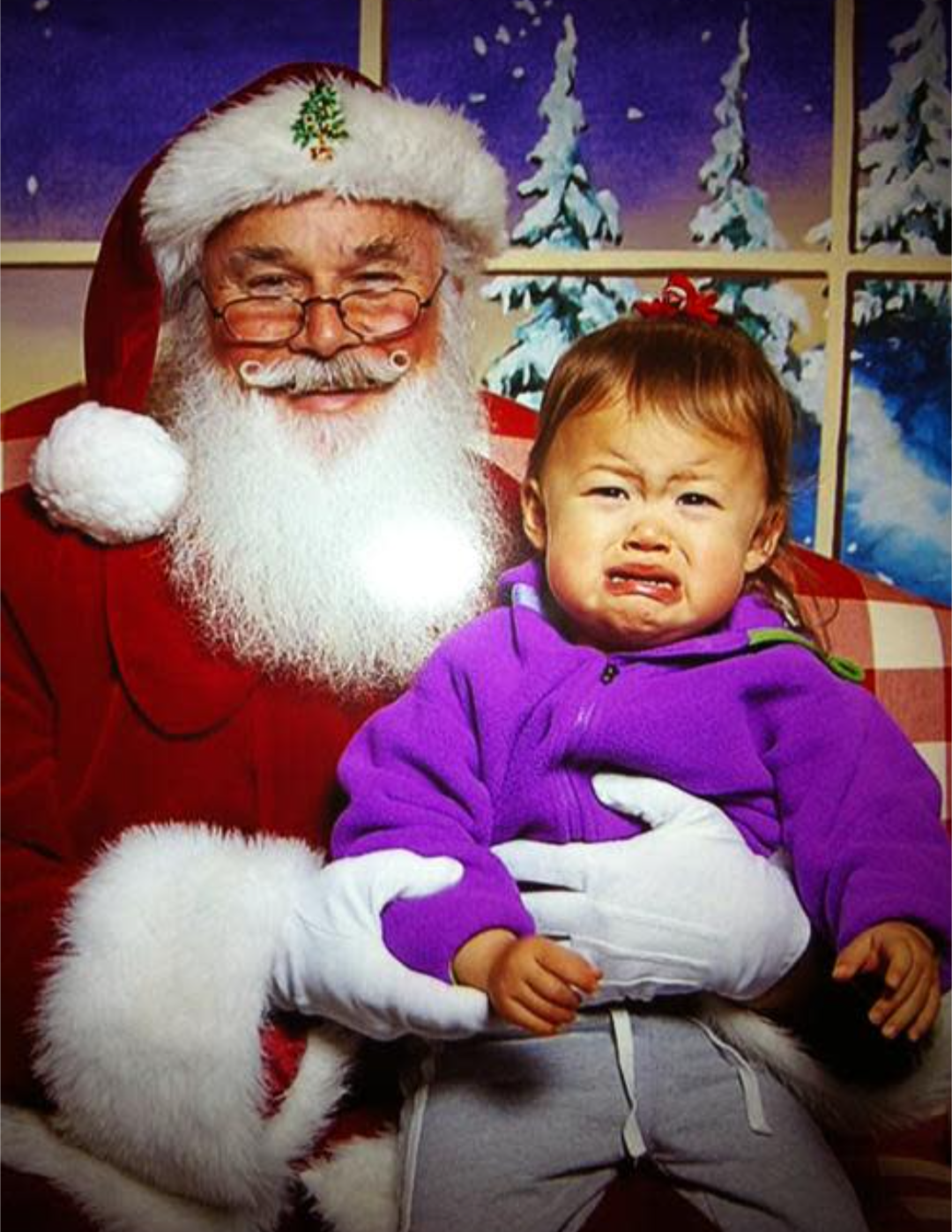
3. Kids meeting Santa. Whether it's sweet or horrifying, this is a classic. The mall Santa or the Santa at the party or the relative who dresses up every year are (virtually) all great. The sweetness of a child's excitement or the panic of the kid who only sees an oversized man in red reaching for them are both tremendous.

2. Decorating the tree. This signifies the official start of the season for most of us. A dramatic decline in real Christmas trees largely removed Step 1 (driving to a Christmas tree lot and paying entirely too much for a tree that doesn't fit in your house), but the rest of decorating – getting out the decorations out, hanging the stockings, listening to Christmas music, finding the remote control that you accidentally packed last year and blamed your spouse for losing – is fantastic.

1. Christmas carols. There is an entire genre of music built around a specific holiday! It's filled with traditional music (how many hymns do you listen to outside of Christmas season?), rhythm-and-blues, pop, country, hip-hop and every other kind of music. Instrumentals. Acapella. Even an over-the-top "American neoclassical new-age music ensemble" like Manheim Steamroller gets a listen. Of all the traditions of Christmas, this is the best because it has the widest impact. Other than the birth of Jesus, I mean.

Enjoy the full holiday season.

Reach Brad Stanhope at Bradstanhope@outlook.com.

Sunday, November 24, 2024

Teenagers aren't the only people who don't finish the job

It was a recurring problem when our sons were teenagers.

After taking a ridiculous amount of food into their rooms to eat – cereal, chips, leftover pizza, frozen taquitos, Mountain Dew – they would bring the dirty plates/bowls back to the kitchen, rinse them out . . . and then leave them on the counter, just above the dishwasher.

It was better than leaving the dirty dishes in their rooms, but they rarely finished the job. The hard part was bringing the plate to the kitchen and rinsing it. The last 10% of the job was putting it in the dishwasher. That part was easy.

It's not just teenagers who do 90% of the job and stop. There are many things in life where we do the equivalent of running 25 miles of a marathon and then stopping (that's an overstatement. Bringing a plate to the kitchen from your bedroom is not like running 25 miles).

Here are five common areas in which we do 90%, then inexplicably stop. And we don't have a good excuse.

Putting a new bag in the trash can. We take out the garbage – which often involves pulling out a bag of refuse, hauling it to wherever our larger garbage can is and returning – then neglect to put a new bag in the can. It's a problem, but it's worse if someone assumes there's a new bag in there and dumps a plate of spaghetti. We only did 90% of the job.

Filling a hand soap dispenser. If you use liquid soap, you know this routine: We get low on the hand soap, but we just keep dispensing smaller and smaller amounts. Pretty soon, it's spitting out a spray of soap. Do we think it will magically fill? The hard part was getting the dispenser and getting a refill, but we keep getting smaller and smaller amounts of hand soap without refilling it. We only do 90% of the job.

Emptying suitcases after a trip. We take the time to correctly pack a suitcase, then live out of it for a day, a week or 10 days. We return home, with a few items of clean clothes, a bunch of dirty clothes and some other stuff. We endure the travel, we make it home, we bring in the suitcase . . . and leave it. A few days later, there are still clothes in your suitcase. We only do 90% of the job.

Putting the new toilet paper on the roll. The hard part – if you can call it that – is getting the additional roll out of storage. But too often, we get a new roll, put it on the counter near the toilet, maybe use it, then walk away. It would have taken 10 seconds to put it on the roller. We were literally sitting there. We only do 90% of the job.

Folding clothes after laundry. It takes a couple of hours to wash and dry a load of laundry. We have to gather it (or take a hamper), put it in the washing machine, pull all those wet clothes out and transfer them to the dryer. Later, we load the dry clothes in a basket, take them to a bed or wherever we place them, dump them and . . . leave them. It takes three minutes to fold a load of clothes, but we do only 90% of the job.

There are probably other tasks you can think of – tasks where we routinely do the hard 90%, but don't finish it.

It would be like me writing this column and not having a final paragraph that wraps things up.

Maybe I'll do that later.

Reach Brad Stanhope at bradstanhope@outlook.com.
Sunday, November 17, 2024

Why we don't need to give our autographs anymore

In the early 1990s, I was working as a Daily Republic sports writer, covering an Oakland A's-Minnesota Twins baseball game at the Oakland Coliseum. About 90 minutes after the game – having interviewed the managers, some players and written a game story or column – I walked out of the stadium toward my car.

As always, a collection of fans – mostly young fans – waited outside the tunnel that led from the Coliseum clubhouses to the parking lots, looking for autographs.

"Hey, are you Scott Erickson?"

I didn't respond at first. Then I realized it was a kid. Maybe 10 or 11. Asking me if I was Scott Erickson, an outstanding pitcher for the Twins (he won 20 games one season). Scott Erickson was 6-foot-4, 220 pounds. I was 5-foot-10, 175 pounds. He was six years younger than me. But we both had dark hair, I guess.

The kid wanted an autograph!

"No, sorry," I said, feeling bad for the kid, but great for me. He thought I was a major league baseball player! I was a sports writer for a small newspaper who occasionally played city league softball (badly). But he thought I was somebody! I was like Navin Johnson in "The Jerk!"

That feeling stayed until a few days later when I covered my next game. Same thing. Game ended. I wrote my article and headed out to my car.

"Hey is . . . no, never mind. He's not a player." 

Different kid, very different (and accurate) perception. No autograph in either case, but one gave me the illusion that I had some sort of similarity to a 6-foot-4 guy who could throw a baseball 90 mph.

I didn't give any autographs because they weren't needed. Just like they're not needed for a credit card.

(Columnist trick! If you can't think of a way to lead into a subject, consider something similar, write about it and then add a paragraph to explain the correlation. In this case, follow that paragraph with a parenthetical paragraph explaining what you did. You learned something today.)

Did you know that you don't need to sign a credit card receipt? That when you go to a restaurant and put the meal on a card, when they bring you back the card, receipt and a list of suggested tips, you can write a total and not sign the card?

It doesn't matter and it hasn't mattered for a long time. In fact, Visa, Mastercard, Discover and American Express (all the major cards except Diners Club, which I just discovered still exists but is not issuing new cards in the United States) all dropped the requirements to sign.

In 2018. Six years ago.

We haven't needed to sign credit card receipts (or those credit card readers) for six years!

Still, many places expect us to sign for the card purchase to be "official." It doesn't make it official. Signatures are not even used to detect fraud. No one checks your signature against anything because the card companies stopped requiring signatures in 2018.

I don't know how that makes you feel. It makes me feel like we're continuing a social contract that's outdated, like not wearing white after Labor Day or men taking off their hats while indoors or using a duel to settle a dispute. We don't have to sign for our credit cards!

However . . . while I think it's a good idea for you to make a scene at a restaurant by refusing to sign, I'm not going to be the guy who tries to explain this to a waiter who brings me the ticket. I'm not going to tell the cashier at CVS that my signature isn't required because that went away six years ago. I'm not going to refuse to sign when I get a haircut and the stylist (or barber) asks me to sign.

I'm not going to do it for the same reason I wouldn't pretend to be Scott Erickson. I'm not doing it for the same reason I didn't tell the kid who said I wasn't an athlete that I could switch hit and ground out to second base from each side of the plate in softball.

Because it's sometimes easier to go along than to make someone uncomfortable.

It's what Scott Erickson would do, at least. And I don't know if I've ever told the story, but I was mistaken for him once ...

Reach Brad Stanhope at bradstanhope@outlook.com.

Sunday, November 10, 2024

An invaluable lesson learned as a young McDonald's employee

The good folks at McDonald's say that one in eight Americans will work at one of their franchises at some point of their lives. You deserve a break today, so my high school stint at McDonald's can offset that statistic for you and six other people.

Politicians and business leaders have used their McDonald's experience to burnish their working-class appeal. Kamala Harris worked at McDonald's. Jeff Bezos worked at McDonald's. Heck, Jay Leno worked at McDonald's.

Brad Stanhope also worked at McDonald's. There, I learned one of life's most important lessons: Stay focused.

McDonald's was an important job for me. After losing my first two positions (including at a supermarket where I was fired by a boss who told me in the middle of the store that I didn't need to come in anymore), my confidence was shaky. Working at McDonald's allowed me to be around plenty of people, get training and realize that I wasn't (totally) incompetent.

I was a senior in high school, working at McDonald's in my hometown of Eureka. One of the roles I filled was being the guy who emptied garbage cans, cleaned the bathrooms and was a gofer for everyone. That wasn't all I ever did – I also took orders and repeatedly scalded my arms while making french fries – but on the winter night in question, I was the cleanup guy.

It was wet and cold around 8 p.m., which is typical for that area. The Pacific Ocean was a few blocks west of the restaurant, so it was foggy. As I remember it, there were just a handful of cars in the large parking lot.

I checked the three garbage cans spread around that massive parking lot. Being Eureka, there were always people wandering around. There was a substantial homeless population even then and some of those residents would look in the McDonald's dumpster, searching for food. That made sense because we would make the food, set a timer and throw it out after a certain period.

Anyway, I wandered the dark parking lot thinking of whatever a 17-year-old thought of in that era. Sports. Girls. School. "Welcome Back, Kotter." The Bee Gees. I grabbed one full bag of trash, went to another can and grabbed that bag. Then I walked to the dumpster, climbed up the short ladder, opened it and . . .

A GUY SPRUNG UP LIKE SOMEONE JUMPING UP FROM A CASKET.

OR MAYBE FROM A JACK-IN-THE-BOX.

I gasped and almost fell off the ladder. What the heck? 

The guy was equally surprised. He was dumpster diving, about to find some food when . . . some kid opened the lid and surprised him!

I didn't tell him to leave. I probably apologized for bothering him. I tossed the bag to the part of the dumpster away from him and told him it didn't have any good food.

I was mad at myself. I wondered if I screamed. I hoped I didn't make the guy feel bad. I was mad that the guy was there.

Nobody saw it. Nobody knew about it. I doubt I am the only employee of that or any McDonald's who had that experience. But it stuck with me: Always stay focused.

When Bezos or Harris or Leno talk about working at McDonald's, they probably don't think about nearly having a heart attack caused by a Jack-in-the-Dumpster experience when they were 17 and thinking how weird it was that John Travolta was in movies, too.

Yeah, I worked at McDonald's.

I made friends there, gained confidence and learned an important lesson: When putting trash in Dumpsters, always be cautious.

I'm lovin' it!

Reach Brad Stanhope at bradstanhope@outlook.com.


Sunday, November 3, 2024

America changes this week, the toy hall of fame and more

This is the week that America changes.

Things will be different. Whether it's brighter or darker depends on your outlook, but change is coming.

Yeah. In case you missed it (far less likely now than before our electronic devices updated automatically), daylight saving time ended early Sunday morning. It's now standard time, which means it's dark earlier in the evening and we can all settle into months of sadness.

Most of us have strong opinions on whether it our current system makes sense.

Some of us like daylight saving time and think it should be in place all year, rather than just eight months. Some of us think we should stay on standard time year-round. Some of us think we should pick a lane and not have to change our clocks twice a year (particularly our car clocks).

I don't know who's right, but I think we should learn that we can have vastly different views of issues and not hate the other side. If you're a DST denier, I think you're wrong, but I don't think you're evil. You may just not have the same information as me.

It seems like that may apply somewhere else this week, but we'll see.

While we're on the topic, consider my latest proposal with daylight saving time: What if instead of springing forward and falling back, we just fell back every time the time changed? Fall back in the spring, fall back in the fall.

Of course, that would hamper the idea of longer summer days (at first), but it would . . .  are you ready . . . have a time-shifting element unlike anything else. Falling back twice a year would result in us getting an extra day every 12 years. It wouldn't change the calendar, it would just mean that over time, we're stealing an extra day.

We could defeat time!

On to the topics du jour. . . . 

✸✸✸

If you're like me, you're losing sleep over this month's big election.

Correct! We're about to discover the makeup of the 2024 class for the Toy Hall of Fame. The Strong National Museum of Play announced 12 finalists back in September, but most observers think it's likely time for balloons and trampoline to break through and gain entrance to the toy shrine. Pokemon cards and Transformers – popular with generations younger than me – also seem likely to get in.

One beneath-the-radar toy that might sneak in: The stick horse.

✸✸✸

OK, something equally important: Why do manufacturers put peel-off caps on products, but leave off the tab that makes it easy to pull off the caps? I mean, it's bad enough that I have to pull a metallic cap off my toothpaste tube, but how am I supposed to do that when they don't give me something to grip?

It's ridiculous and I generally end up pounding it with tweezers or my toothbrush, like I'm a caveman (who owned tweezers and an electric toothbrush). If you put a peel-off cap on a product, give us a tab that's easy to grab.

It's simple decency.

✸✸✸

No TV show in the history of broadcasting has been more pleasant than "The Great British Baking Show." It's now in its (I'm estimating) 1,500th season, but every season features a bunch of really nice people baking tasty items in a good-natured competition at a country house with pleasant music playing.

Anxious about Tuesday's election? Binge watch that show.

Reach Brad Stanhope at bradstanhope@outlook.com.


Sunday, October 27, 2024

Four out of five dentists surveyed said you should read this column

Evolution is slow until it isn't.

Dinosaurs roamed freely in the American West for hundreds of years before they all died in the Revolutionary War. Men treated women as inferiors until Billie Jean King beat Bobby Riggs in a tennis match in 1973, settling gender equality forever. Soccer was the only sport in the world until an intrepid Irish player touched the ball with his hands and lived – leading to the rise of baseball, basketball and team handball.

(Don't fact-check me. Trust me.)

We live in a period of dramatic changes in short periods. The rise and fall of the BlackBerry, the explosion of remote and hybrid work, the disappearance of traditional tube televisions, the rise and fall of Paris Hilton. As legendary philosopher Ferris Bueller said, “Life moves pretty fast. If you don't stop and look around once in a while, you could miss it.”

Keep reading. My point is three paragraphs away.

I don't know when hairy chests for men went from sexy to disgusting, but it took a while and I missed it. Few of us can pinpoint the year when children went from calling adults "Mr." or "Mrs." and started calling them by their first names. I missed that, too.

Who can pinpoint when yellow stopped being a common color for kitchen appliances or when men started growing sideburns again? Not me.

Finally: It's hard to pinpoint exactly when we stopped chewing gum.

Gum chewing is down. The number of Americans who chewed gum at least once a year dropped 12% over the past decade-plus. In 2024, less than half of Americans say they'll chew gum (at any point of the year!).

The gum-chewing bubble has popped (GET IT?).

Back in the day, everyone chewed gum. Gum-chewing was almost as common as cigarette smoking – which leads to the possibility that the two are linked in ways beyond Nicorette. We had the gum-chomping waitress as a pop culture icon (hello, Flo from "Alice"!). Anxious cops chomped gum in movies. Baseball players chewed gum (if they weren't chewing tobacco). Kids in school chewed gum and stuck it on the bottom of their desks. Every mom had gum in her purse, even if it was something like Dentyne or Wrigley's.

But it's gone down. Way down.

Think of the last time someone rudely chomped on gum while talking to you. It's been a while, right? Consider this: When was the last time a fitness trainer who discourages situps said, "If using a muscle over and over makes it strong, why don't people who chew gums have huge jaws?" (Ignoring the fact that the jaw is not a muscle and also ignoring the fact that doing situps is not designed to make your torso bigger!)

Anyway, Big Gum noticed the decline. They realized the path to keeping their product viable is more than just having attractive twins chew gum (the old Doublemint commercials) or telling us gum chewing can help keep our teeth healthy (like Dentyne did). 

According to an article on Food Dive, Hershey (who knew they sold gum?) is introducing a version of Ice Breakers gum where the flavor keeps changing (presumably not the traditional gum-flavor change that goes from five seconds of flavor to tasteless cardboard). Hubba Bubba now has a Skittles-flavored gum. Another company has introduced caffeine-infused gum, for people who would rather chew their coffee. 

Shockingly, Big League Chew is making a comeback – although mimicking chewing tobacco seems outdated in a world where major league baseball has banned most tobacco products. This emphasis is happening through partnerships with college athletes who show Big League Chew as fun, since mouth cancer seems like a blast.

Gum manufacturers are following a playbook for when a product loses steam: jazz it up and make it popular for a new generation.

We'll see if it works. On one hand, I lament the end of a familiar characterization of people. On the other hand, it's been a while since I stepped on sticky gum that some idiot spit out on a sidewalk.

Is gum going away? Is it a good thing? I'm not sure, but I'm interested to see if gum goes the way of dinosaurs and disappears after a few hundred years.

Four out of five dentists say that's happening.

Reach Brad Stanhope at bradstanhope@outlook.com.

Sunday, October 20, 2024

It's time to move away from arbitrary (6 foot) ideas about height

I've been 5 foot, 10½ inches for decades. I was that height when I married, when I turned 30, when I got gray hair, when the 49ers won their last Super Bowl and when the Giants won their last World Series (events that were 19 years apart). 

About 15 years ago, I went in for an annual physical and they measured me as . . . 5-11.

I was growing! The dream of being 6 feet tall was still alive! Maybe I'd reach that magical landmark by the time I was 50 or 60 or 70. Things were really going to start happening for me!

The next year, I measured 5-10½ and the dream was done.

Except the "dream" is the result of a strange allegiance to round numbers and the imperial measurement system.

Think about it: Even if we've decided that a whole number is better than a fraction (that 6 feet even is superior to 5 feet and a fraction of a foot), who made the decision that we'd ignore the logical decimal system and instead go with the imperial system of inches, feet, gallons and pounds?

Other than all of America in the 1970s, I mean. Because when I was in elementary school, we were told that by the time we were adults, we'd be measuring things by the decimal system. Alas, that was over by the time I was in high school as we determined the decimal system, like disco music, sucked.

Back to the point: Think of the pain caused by the ridiculous belief in the superiority of 6-foot men  (apparently, many women in dating apps say they want their man to be at least 6 feet tall).

We all apply arbitrary standards. We like baseball batters who hit .300, not .299. We recognize the world record in the 100-yard dash, not the 95-yard dash. We talk about a 10-gallon cowboy hat, not an 8-gallon hat. Denver is the Mile-High City for a reason. 

I'm not suggesting we stop having ideals. After all, if we did that, what would happen to iconic things like "My 600-Pound Life" or "The Hundred Years War" (other than reducing voyeurism or celebrating long-ago wars)?

Here's my suggestion: Follow the European model.

Generally, I'm an America-first person. They shouldn't call soccer "football." We should drive on the right side of the road. We shouldn't endorse official naps during the workday.

However, there's one European model with which I agree: The standard for male height shouldn't be 6 feet tall. It should be 180 centimeters.

Who disagrees with that? Of course! One hundred eighty centimeters makes sense!

(First, I Googled, "convert 180 cm to feet" and found that it's between 5-10½ and 5-11. In other words, if I stand up really tall and don't get a haircut for a few months before a doctor's appointment, I might reach 180 cm. Wonderful!)

Of course, it would be simpler if we weren't hung up on multiples of 10. For instance, I think it's reasonable that 179 centimeters were considered the ideal, since it's slightly shorter than 5-10½. At least that seems ideal until I start shrinking. Maybe 178 centimeters or even 175 centimeters.

Wouldn't the world be better if we didn't set arbitrary numbers for ideal heights, weights, IQs and income? Especially since all of my figures – except weight – are gradually declining.

Reach Brad Stanhope at bradstanhope@outlook.com.

Sunday, October 13, 2024

What Mrs. Brad really fears will happen to me if she dies first

Mrs. Brad and I were taking our regular Saturday morning hike around our community on a recent warm day. We walk, talk and comment on our neighbor's houses. We greet people and shake our heads at those who walk past us and avoid eye contact.

We'd talked about our kids, jobs and plans for the day. We asked some questions that we would later Google ("What are the main predators for coyotes?" "What's the difference between England, Great Britain and the UK?" "Did Hawaiians invent the ukelele?"). We were getting our exercise, sharing our lives and having a good time.

And then . . . 

"If I die before you, I want you to promise me something," she said.

Geez. Out of nowhere!

While on a relaxed walk, Mrs. Brad was asking me to promise to do something if she dies first. Things had suddenly gotten deep.

Side story: A few years ago, she announced, "After you die, I'm going to . . . " I interrupted her. "What makes you think you'll outlive me?" She looked at me and started again, "After you die, I'm going to make it easier for our sons. I'll move close to them if they don't live here."

Nothing dramatically changed since that day, so I don't know why her outlook changed. She has no fatal disease and I haven't discovered the fountain of youth. But suddenly she was extracting a promise from me.

I started anticipating her request. The most likely ask was for me to not be stubborn but to allow our sons to take care of me. That was by far the most likely request.

It was unlikely she'd have an opinion on whether I'd remarry or grow a beard or become vegan. What did she want me to promise?

After waiting for me to say OK (which I did by saying, "OK."), she made her request:

"Promise that you'll get professional housekeeping."

What?

What?

My wife, to whom I've been married nearly 40 years, who I fell in love with when I was 18, who I partnered with to raise two sons with me and who has been my teammate in every area of life since the Reagan administration (or since Chris Brown was the Giants third baseman, depending on your historic reference point), had one request for me if she dies first. That I hire a housekeeper.

I was baffled. While I don't see all the dirt she does, I'm not a slob. I do the dishes and vacuum and pick up the house regularly. I did all of our laundry for decades. I'm the grocery shopper.  But if she dies first, her first concern is not that I let our sons help me, but that I let a housekeeper clean the house once a week or once a month or whatever.

Second side note: There's no problem with hiring professional housekeeping. It makes sense. We've done it. But that's the thing that most concerns her?

I was befuddled. It was an easy request Of course, I'll do that (as far as she knows).

Later, I wondered why the request shocked me so much. Why did it seem to come from left field (Giants left fielder the year we married: Jeffrey Leonard. HacMan!). 

I landed on five possible reasons the request surprised me:

1. I've watched too many movies where a character makes a romantic request of their loved one while dying. In the real world, maybe people have practical plans. Such as keeping their posthumous house clean.

2 Mrs. Brad fears I'll have people over after she dies and they'll judge her if my house is dirty.

3. It's crazy.

4. Mrs. Brad secretly signed up for a multilevel marketing scheme involving house cleaners and told her "manager" that I had agreed to pay for housekeeping at a future date.

5. I'm actually a slob but don't realize it.

I don't which is true (oddsmakers have No. 5 as the heavy favorite). I just know the next time Mrs. Brad wants me to promise something if she dies first, I'll be ready for anything. ("That you'll eat salad once a week." "That you'll take up horseshoes." "That you'll never wear suspenders." "That you'll keep your eyebrows trimmed.")

In the meantime, I'll search the house for a document where she added me to a list of people she's registered for future housekeeping services.

Maybe I found a loophole: If I'm truly going to let our sons help me, they can clean my house.

Reach Brad Stanhope at bradstanhope@outlook.com.